

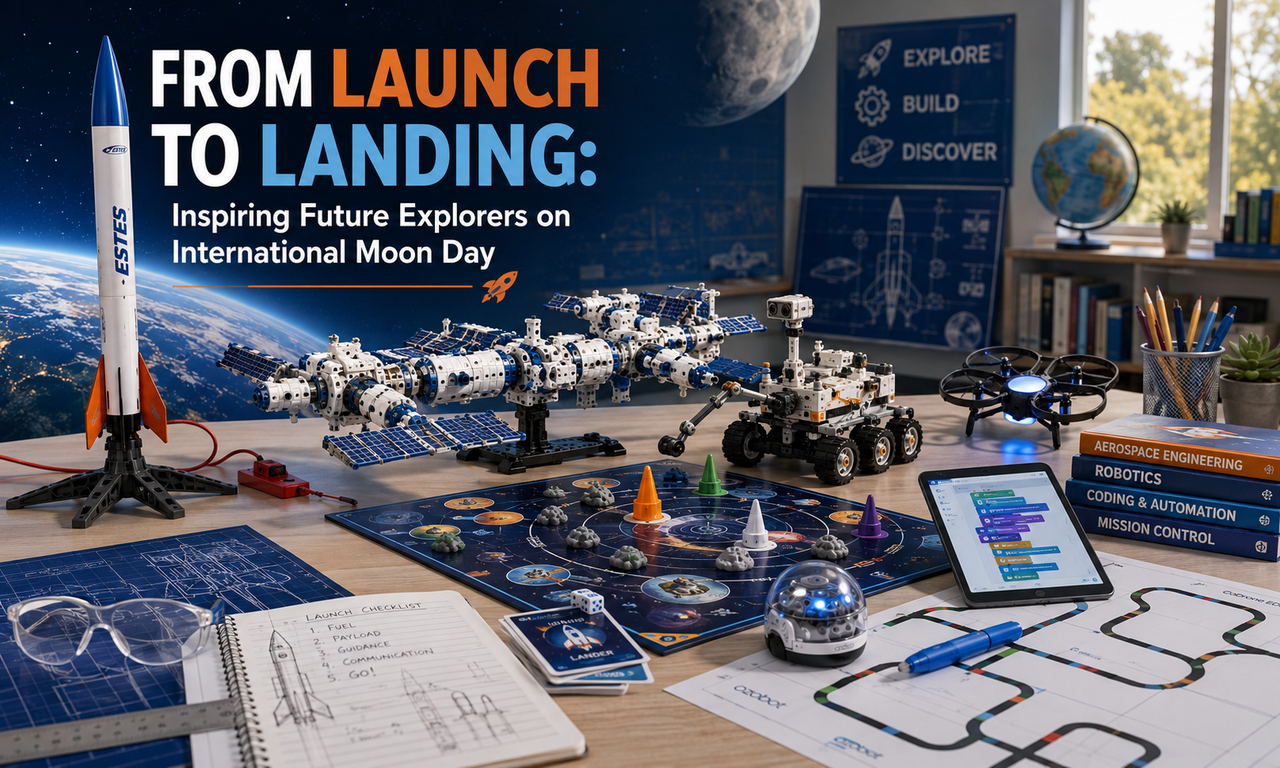
From Launch to Landing: Inspiring Future Explorers on International Moon Day
Posted by Geyer Instructional Products on 9th Jul 2026
From Launch to Landing: Inspiring Future Explorers on International Moon Day
✨ Every great discovery begins with curiosity.
On July 20, International Moon Day, we celebrate one of humanity's greatest achievements—the Apollo 11 Moon landing. More than fifty years later, that historic mission continues to inspire scientists, engineers, programmers, and innovators around the world.
Behind every successful mission are the STEM skills students are developing in today's classrooms: engineering, coding, robotics, automation, critical thinking, and problem-solving.
International Moon Day is the perfect opportunity to help students discover how today's classroom activities connect to tomorrow's careers.
Mission 1: Build the Foundation
Every space mission begins long before liftoff.
Engineers spend years designing, testing, and refining every component before a rocket ever leaves the launch pad. By building and launching model rockets, students experience that same engineering process while learning the science behind flight. Students explore concepts including:
- Newton's Laws of Motion
- Thrust and propulsion
- Gravity
- Aerodynamics
- Flight stability
- Observation and data collection
Whether launching the Estes Space Shuttle, recreating history with the Estes Saturn 1B Rocket Launch Set, or designing creative missions with the Estes Space2Inspire Premium Kit, students discover that engineering is built on curiosity, testing, and continuous improvement.
Mission 2: Explore Beyond Earth
Landing on the Moon was only the beginning.
Today's space missions continue to explore the Moon, Mars, and beyond using advanced robotic technology.
The BK06 Mars Rover Aerospace Building Block Set gives students a hands-on introduction to planetary exploration while strengthening engineering and design skills.
As they build, students begin asking questions real engineers face every day:
- How do robots explore another planet?
- How do engineers solve problems from millions of miles away?
- What makes a rover reliable in extreme environments?
These activities encourage creativity, teamwork, and perseverance while introducing students to the engineering design process.
Mission 3: Automation Makes Exploration Possible
Modern space exploration depends on automation.
From autonomous spacecraft to planetary rovers and satellites, computers constantly collect data, navigate obstacles, and make real-time decisions.
With CoDrone EDU, students move from learning about automation to programming it themselves.
Students can:
- Program autonomous flight
- Navigate obstacle courses
- Use onboard sensors
- Collect environmental data
- Build computational thinking skills
These same programming concepts are used throughout aerospace, robotics, manufacturing, and countless other industries.
Mission 4: Think Like Mission Control
Every successful mission requires more than technology.
Behind every launch is a team that plans, communicates, analyzes data, and adapts to unexpected challenges.
The Rocket Lander STEM Strategy Board Game encourages students to think like mission control by developing:
- Strategic thinking
- Collaboration
- Decision-making
- Critical thinking
- Communication
- Problem-solving
Students learn that great engineering is built on teamwork as much as technology.
Building Tomorrow's Workforce
Students explore careers including:
- Aerospace Engineering
- Robotics
- Artificial Intelligence
- Software Development
- Mechanical Engineering
- Drone Technology
- Data Science
- Advanced Manufacturing
By connecting classroom STEM activities to real-world careers, educators help students understand that today's lessons can lead to tomorrow's innovations.
Celebrate International Moon Day Through STEM
The Apollo 11 mission proved that curiosity, determination, and collaboration can accomplish extraordinary things.
This International Moon Day, inspires students to explore the science behind space exploration through hands-on learning experiences that combine rockets, robotics, engineering, coding, and automation.
Whether students are launching rockets, building a Mars rover, programming a CoDrone EDU, or solving challenges through strategic gameplay, they'll develop the same skills that continue to drive innovation on Earth—and beyond.
❓ After all, every future engineer, programmer, and explorer starts with one simple question:
"What if?"
 Recently Viewed