

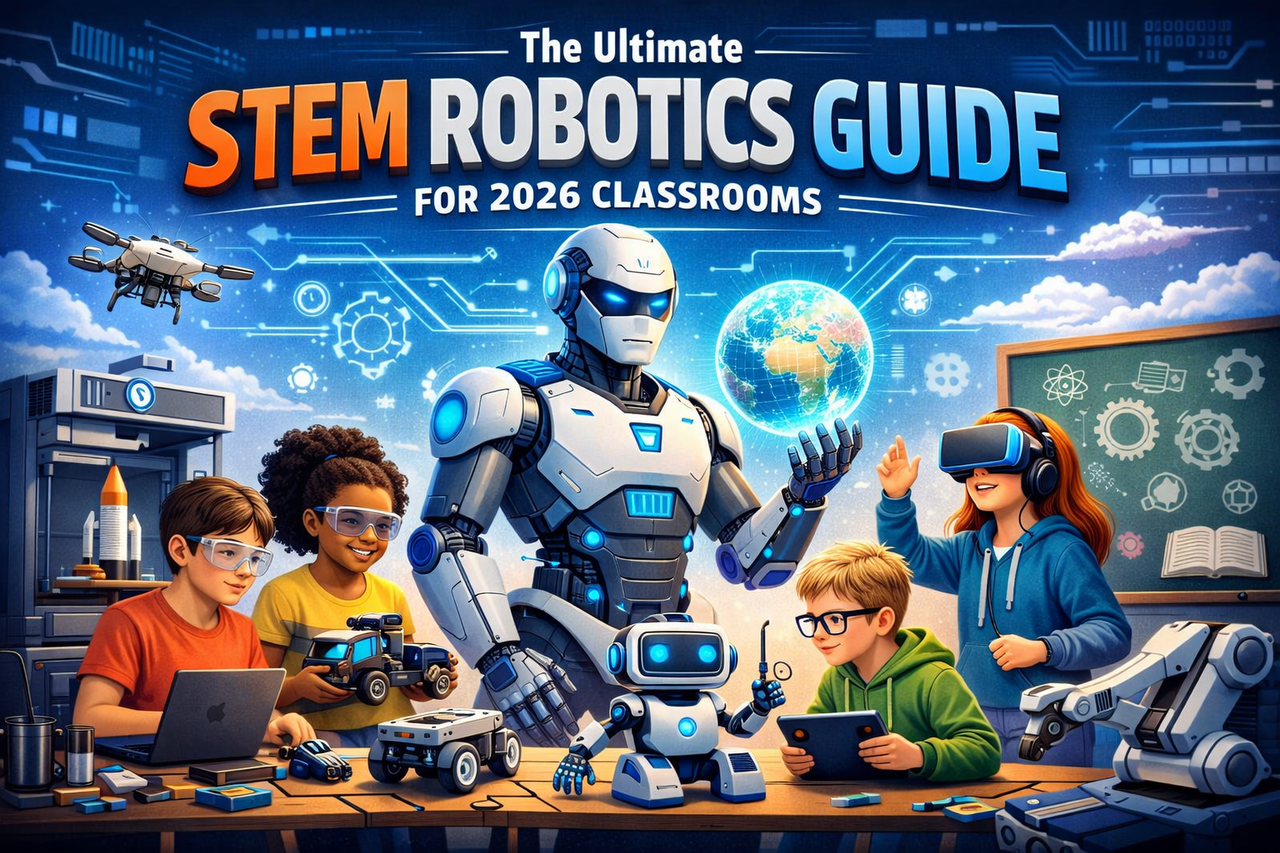
The Ultimate STEM Robotics Guide for 2026 Classrooms
7th Apr 2026
The most effective classrooms in 2026 use hands-on, structured STEM Robotics programs that help students move from simple logic to real problem-solving. From our experience working with STEM labs, success comes from step-by-step coding, sensor feedback, and learning through trial and error.
We’ve seen a clear shift in classrooms. It’s no longer just about building a robot. It’s about helping students understand how systems think, react, and improve over time.
Why Are 2026 Classrooms Rethinking Robotics Education?
What’s broken in traditional robotics teaching?
In many classrooms, students follow steps and complete builds. But they often don’t understand what they are doing.
We’ve observed three common problems:
- Students focus only on finishing the build
- They copy instructions without thinking
- They don’t connect learning to real life
This creates a gap. Students can build, but they can’t explain or apply what they’ve learned.
What are educators doing differently now?
Teachers are now shifting their approach. They are starting with problems instead of instructions. Students are asked to solve tasks, not just assemble kits.
They also connect robotics with real-world situations. This helps students see meaning in what they are doing.
This shift changes how we introduce robotics from the very first lesson.
How Do Students Progress from Simple Coding to Real Robotics Thinking?
What is the “scaffolded logic” approach?
We always teach in steps. Students should first understand basic logic before moving to complex systems. They begin with visual coding. Then they move to text-based programming.
The focus stays on key ideas like conditions, loops, and variables. These ideas work across any system, not just one robot.
Why does this progression matter more than the robot itself?
From what we’ve seen, tools change. But thinking stays.
When students learn logic:
- They can work with any platform
- They don’t depend on one system
- They build confidence over time
As one middle school STEM teacher we’ve worked with shared, “When students move from block coding to writing their own simple Python logic, you can actually see the shift. They stop guessing and start thinking step by step.”
Once students understand logic, the next step is helping them interact with the real world.
How Do Robots Actually “Think” Using Sensors and Feedback?
What is a closed-loop system in simple terms?
A robot works in a loop. It senses, processes, and reacts. Sensors collect information. The code reads that data. Then the robot changes its action.
This is how real machines work.
Which sensors bring learning to life?
Students learn better when they can see results.
Ultrasonic sensors measure distance. Infrared sensors detect objects. Gyroscopic sensors help with balance and direction.
Why is this powerful for students?
It turns ideas into action.
Math becomes movement. Science becomes visible. Students can see cause and effect in real time. For example, a robot can stop when it gets close to a wall. Students can clearly see how logic controls behavior.
But understanding systems is only part of the learning. The real growth happens when things don’t work.
Why Is Failure the Most Valuable Part of Robotics Learning?
What does “glitch-as-gift” look like in a classroom?
In our experience supporting classrooms, failure is where real learning begins.
When a robot fails, students don’t give up. They start thinking. They test ideas. They try again. Debugging becomes a normal part of learning, not something to avoid.
How do teachers structure this effectively?
Teachers now use real-world challenges instead of fixed instructions.
For example, students may build a robot that must move through obstacles or complete a task under certain conditions. This creates a space where mistakes are expected and useful.
What works best in real classrooms:
- Let students test ideas freely
- Focus on improvement, not perfection
- Encourage students to explain what went wrong
This approach builds strong thinking habits. It also increases engagement.
This mindset also opens the door to something bigger, cross-disciplinary learning.
How Can Robotics Connect Math, Science, and Even Creativity?
How does robotics support multiple subjects?
We’ve seen robotics work best when it connects with other subjects.
Students can use robots to plot points in math. They can test motion in science. They can even create stories where robots act as characters.
Why does this improve engagement?
Students stay interested when learning feels useful. They understand concepts faster because they can apply them right away. This is where robotics education becomes more than a subject. It becomes a way to teach thinking across subjects.
To implement this well, schools need to match tools with student readiness.
Which Robotics Tools Are Right for Each Grade Level?
Choosing the right tools matters. We always recommend matching the tool with the student’s level.
|
Grade Level |
Core Learning Objective |
Recommended Interface |
|
K–2 |
Sequential logic & patterns |
Screen-less bots |
|
3–5 |
Loops & simple sensors |
Snap-together kits |
|
6–8 |
Variables & conditions |
Multi-sensor systems |
|
9–12 |
Engineering & data systems |
Advanced coding platforms |
Why does matching complexity matter?
If tools are too hard, students get stuck. If they are too easy, students lose interest. The right level helps students grow step by step and builds strong STEM learning habits.
Beyond tools, schools also need alignment with standards and infrastructure.
How Do Schools Align Robotics with Standards Like NGSS and ISTE?
What standards does robotics naturally support?
Robotics fits well with existing standards.
It supports engineering design and physical science concepts like motion and force. These are already part of many school systems.
What does a complete robotics ecosystem include?
A strong setup includes proper storage, charging systems, and space for building and testing.
Across the classrooms we’ve supported, we’ve consistently observed that structured STEM environments lead to better results. Schools that implement organized lab setups and guided lesson frameworks often report higher student participation, fewer disruptions during sessions, and improved completion rates for project-based tasks.
In many cases, teachers also share that once systems are in place, setup time drops significantly. This allows more time for actual learning and problem-solving during class.
We’ve seen that when classrooms are well organized, teachers spend more time teaching and less time managing. Of course, even the best setup needs reliable tools and support.
What Makes a Robotics Program Reliable in Real Classrooms?
Why does durability matter more than features?
Classrooms are active environments. Tools are often used.
If materials break, learning stops. That’s why reliability matters more than extra features.
What builds long-term trust?
Teachers need support, not just products.
A strong program includes:
- Teacher training
- Ready lesson plans
- Ongoing support
This becomes especially important when introducing coding for kids at an early stage.
All of this leads to one clear idea about robotics in 2026.
Conclusion: What Defines a Future-Ready Robotics Classroom?
A future-ready classroom is not defined by advanced tools. It is defined by how students think.
Across programs we support:
- Students learn best when they build step by step
- Failure helps them improve faster
- Real-world problems keep them engaged
When done right, robot programming becomes a process that students understand and improve every day.
The goal is simple. Help students think clearly, test ideas, and keep improving. That’s what prepares them for the future.
FAQs
1. What is STEM in robotics?
STEM in robotics is the use of science, technology, engineering, and math to design, build, and program robots. It helps students understand how machines sense, think, and act using code and real-world inputs.
2. How should beginners start learning robotics in school?
Students should start with simple activities like basic movement and visual coding. Over time, they can move to sensors, problem-solving tasks, and then text-based programming. Step-by-step learning helps build confidence.
3. Is Stem Robo worth the cost?
Yes, when used properly, it offers strong value. Schools are not just buying kits; they are building problem-solving skills, logical thinking, and real-world understanding. The long-term learning impact often outweighs the initial cost.
4. At what age is it best to introduce robotics to students?
Robotics can start as early as primary school. Younger students can learn patterns and sequences, while older students can handle coding, sensors, and full system design. The key is matching tools to the student’s level.
5. Why is robotics important for future classrooms?
Robotics teaches students how to think, not just what to learn. It builds skills such as problem-solving, teamwork, and logical reasoning, which are useful in many careers, not just technology.
 Recently Viewed