






Micro Fuel Cell Renewable Energy Experiment Kit
SKU: 263430- STEM Education
- Renewable Energy Kit
- Hydrogen Fuel Cell
Details
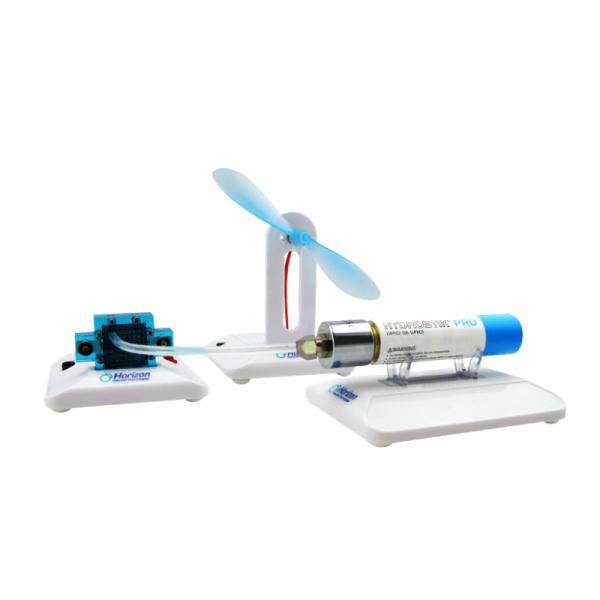
Explore the future of energy storage with Horizon’s Micro Fuel Cell Kit. Power a mini turbine by converting solid state hydrogen in the HYDROSTIK PRO metal hydride cartridge into electrical energy via a Horizon PEM fuel cell. Kids can see the effect as the hydride slowly cools and releases hydrogen into the fuel cell. The process is a model for all micro fuel cell systems— a working example of solid hydrogen storage that can lead to many interesting and creative application ideas.
You will need a source of hydrogen like the Hydrofill PRO to charge the supplied Hydrostik PRO cartridge with hydrogen.
TIP!
Use Horizon Energy Monitor (FCJJ-24) to measure the output voltage & current produced by the fuel cell or do various experiments.
Why Fuel Cells and Hydrogen?
Fuel cells can be thought of as alternative energy devices. They convert chemical energy into electrical energy. Hydrogen fuel cells do this very cleanly, with no toxic emissions, and with a better efficiency. Fuel cells do not generate energy out of thin air. They use hydrogen. Hydrogen is an outstanding carrier of energy. Hydrogen is non-toxic, renewable, easily obtained, and packed with energy. When it combusts with oxygen, it turns into water. This water can again be split into hydrogen and oxygen via electrolysis. The generated hydrogen can be combusted once again, thus undergoing a limitless cycle without toxic emissions. With a fuel cell, you can convert hydrogen into electric current without combustion.
Fossil fuels are converted into usable energy through combustion. The energy released during combustion is inherently difficult to capture and inefficient. It also produces carbon dioxide, which cannot easily be converted back into a usable fuel. A fossil fuel combustion engine at a power plant is only about 30 to 40% efficient. This means it coverts only 30 to 40% of the energy in the fossil fuels to usable energy (electricity). Engines in a car are even less efficient, and reach the level of 15 to 20% of efficiency. Where does the rest of the energy go? It escapes as heat, vibration, and noise.
On the other hand, fuel cells can operate at 40 to 65% efficiency. This means that they can convert 40 to 65% of the energy contained in hydrogen into electricity.
Specifications
Video
Product Attachments
You May Also Like


What Educators are Saying About Geyer
Justin has been nothing but helpful and professional in my requests for these Boeing Defense requirements. He has been able to answer my questions and concerns quickly, and helped in securing the order that I may have made with another supplier had be not been the value-add that he is to your company. I hope his merit raise this FY was "exceeds expectations".
Jesse C...I contacted Geyer via email. I had an email back within minutes!.. A back and forth via email sometimes takes days with other companies and customer service doesn’t happen like this very often. When it does, it’s much appreciated. Brett at Geyer was very polite and accommodating!
John C.The customer service rep went as far as to reach out to the manufacturer of a product to answer my question, and then provided pictures. She really went above and beyond and answered the question thoroughly and gave me exactly the information I was looking for. This entire process was also extremely fast.
Robert C.I called to ask how to submit a Tax Exempt Certificate for my library and spoke to a real person, no automation or asking me to press a number. He was friendly, helpful and got our Tax Exempt status established immediately.
Mischelle F....I don't think I've ever experienced that level of customer service before, and taking it into consideration along with the quality of their products, I would absolutely recommend Geyer to fellow teachers.
Robert S.Trusted By


 Recently Viewed