The Intersection of the 5E Instructional Model, Universal Design for Learning, and Blended Learning: A Framework for Inclusive Inquiry
Posted by Steven M. Yanni, Ed.D. on 18th Mar 2026
Introduction
Designing instruction that is both engaging and inclusive is an ongoing challenge for educators. Increasingly, classrooms must also accommodate different learning environments—ranging from fully in-person to hybrid and online. These conditions demand approaches that are flexible, research-informed, and capable of addressing learner diversity while sustaining high levels of engagement.
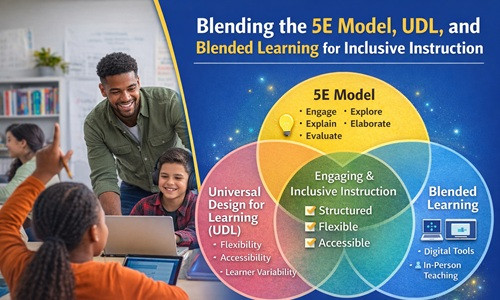
The 5E instructional model, developed by the Biological Sciences Curriculum Study, organizes inquiry learning into the phases of Engage, Explore, Explain, Elaborate, and Evaluate (Bybee et al., 2006). Universal Design for Learning (UDL) emphasizes anticipating learner variability by embedding flexibility through multiple means of engagement, representation, and action/expression (Meyer et al., 2014). Blended learning, meanwhile, provides structures for combining digital tools with face-to-face instruction to personalize learning and expand access (Horn & Staker, 2015).
Though often applied independently, these three approaches are complementary. The 5E cycle provides coherence, UDL ensures accessibility, and blended learning creates flexible modalities for implementation. Together, they support instruction that is rigorous, inclusive, and adaptable to different settings.
Engage: Opening Doors to Curiosity Across Modalities
The Engage phase sparks curiosity and activates prior knowledge. UDL reminds teachers to provide multiple entry points, while blended learning allows these to occur across both physical and digital spaces.
For instance, a science teacher beginning a unit on ecosystems might show a video clip in class, provide an online interactive simulation students can access at home, and post a discussion board prompt for reflection. These options align with UDL’s emphasis on multiple means of engagement and demonstrate how blended learning expands the range of stimuli available. Students can connect in ways that suit their preferences, schedules, and technological access.
Explore: Flexible Investigations in Hybrid Environments
During Explore, students investigate and experiment. UDL highlights the importance of choice, while blended learning increases the range of exploratory tools.
A geometry class might include options such as manipulating physical 3D models, working with digital shape tools online, or completing a collaborative design challenge in small groups. With blended learning, exploration can extend beyond the classroom, with students using virtual labs or cloud-based design platforms. These multimodal opportunities accommodate different learning profiles while keeping inquiry at the core.
Explain: Building Shared Understanding with Multiple Representations The Explain phase formalizes knowledge and introduces academic language. UDL encourages multiple means of representation, and blended learning provides diverse platforms for delivering them.
For example, in a history lesson on primary sources, students might analyze texts in class while also accessing digitized versions with built-in translation and annotation tools online. Teachers might provide short recorded lectures for replay, graphic organizers for visual support, and peer discussion forums. The blended structure allows students to revisit content at their own pace, aligning with UDL’s principle of flexibility while deepening collective understanding.
Elaborate: Authentic Application Through Blended Choice
In Elaborate, students apply concepts to novel contexts. UDL emphasizes authentic tasks with flexible outputs, while blended learning offers digital and in-person modalities for demonstrating mastery.
In an environmental science project, one student might create a podcast and publish it on a class platform, another might design an infographic using digital tools, and a third might deliver a live presentation in class. All tasks require synthesis and transfer of knowledge, but blended environments extend both the authenticity and the reach of student work. Products can be shared beyond the classroom, increasing relevance and motivation.
Evaluate: Equitable and Diverse Assessments
The Evaluate phase measures student understanding. UDL stresses multiple means of expression, and blended learning broadens the possibilities for assessment design.
In literature, students might choose between a traditional essay, a recorded video analysis, or a multimedia presentation posted on a learning management system. Blended tools also allow for ongoing formative assessment: teachers can monitor digital quizzes, reflective journals, or
discussion contributions alongside in-class performances. This diversity ensures assessments reflect what students know, not merely their facility with a single medium.
Discussion
Integrating UDL into the 5E cycle ensures inquiry is inclusive, while blended learning adds flexibility in how instruction and assessment occur. Together, these frameworks provide what might be called a triple-layered approach: the 5E model structures inquiry, UDL ensures access, and blended learning expands modalities across contexts.
This intersection is especially relevant in today’s educational landscape, where digital tools are no longer supplemental but central. As Horn and Staker (2015) note, blended learning provides a pathway toward personalization and equity, while UDL ensures these opportunities are meaningful for diverse learners. Embedding UDL and blended learning within the 5E cycle reduces barriers, supports motivation, and maintains rigor.
Conclusion
The 5E instructional model, UDL, and blended learning each offer valuable contributions to effective teaching. Integrated together, they form a coherent framework that is structured, inclusive, and adaptable. The 5E cycle ensures inquiry-based progression, UDL addresses learner variability, and blended learning provides flexibility across digital and in-person environments. By uniting these frameworks, educators can design lessons that spark curiosity, sustain inquiry, and ensure equitable opportunities for all students to demonstrate mastery.
References
Bybee, R. W., Taylor, J. A., Gardner, A., Van Scotter, P., Powell, J. C., Westbrook, A., & Landes, N. (2006). The BSCS 5E instructional model: Origins and effectiveness. BSCS.
CAST. (2018). Universal design for learning guidelines version 2.2. http://udlguidelines.cast.org
Hall, T., Meyer, A., & Rose, D. H. (2012). Universal design for learning in the classroom: Practical applications. Guilford Press.
Horn, M. B., & Staker, H. (2015). Blended: Using disruptive innovation to improve schools. Jossey-Bass.
Meyer, A., Rose, D. H., & Gordon, D. (2014). Universal design for learning: Theory and practice. CAST Professional Publishing.
 Recently Viewed