
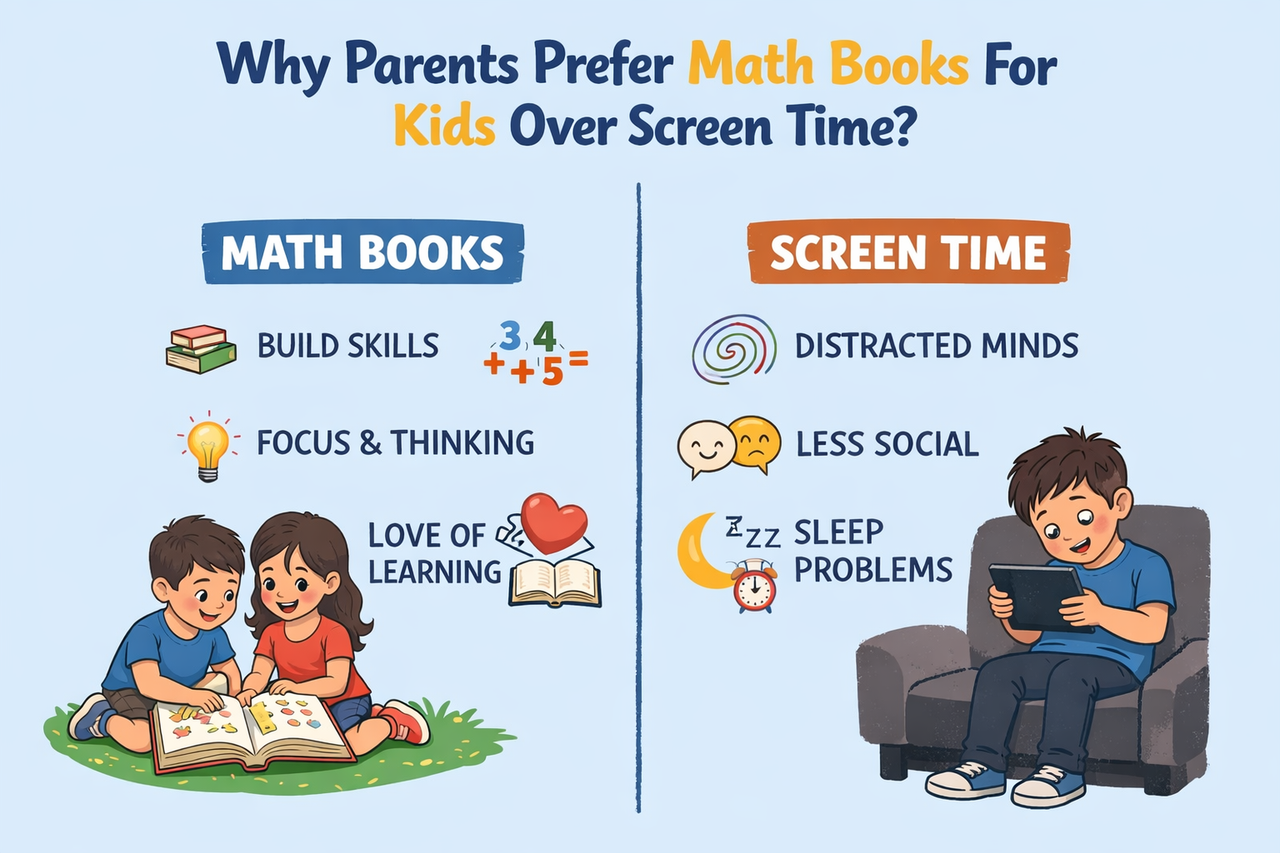
Why Parents Prefer Math Books For Kids Over Screen Time?
18th Feb 2026
We often hear the same concern from parents. Their child spends hours on a tablet, yet learning still feels uncertain. One child jumps between apps, tapping fast. Another sits at the kitchen table with a workbook and a pencil. The second child may seem slower, but learning is visible. Parents can see the thinking happen. This is why many families are returning to Math Books for Kids. It’s not about looking back. It’s about focus, understanding, and steady confidence built one page at a time.
What Do Parents Actually See at the Kitchen Table?
Why does learning look different on paper than on a screen?
Through our work with schools and families, we see clear patterns.
- When children use screens, they often:
- Swipe quickly
- Guess answers to move ahead
- Focus on rewards instead of thinking
- When children use math books, the pace slows:
- They pause before answering
- They flip back to earlier pages
- They trace shapes or numbers with a finger
- They reread instructions out loud
Parents tell us this difference is easy to spot. They can see where their child gets stuck. They can follow how the child is thinking. Learning is no longer hidden behind taps and animations. What families observe at the table matches how children learn best.
This everyday experience connects directly to how the brain processes information.
How Does Writing Math by Hand Strengthen Understanding?
What is haptic learning, and why does it matter in math?
Writing math engages more than just the eyes. It uses the hands and the brain together.
- Holding a pencil builds fine motor control
- Writing slows thinking in a helpful way
- Lining up numbers supports accuracy
When a child writes “2 + 2 = 4,” the action helps lock the idea into memory. This process is known as haptic learning.
On a screen, every tap feels the same. There’s no resistance. That makes it easier to forget steps and ideas. Writing builds stronger memory paths and supports long-term problem-solving. This is why many families still rely on Children’s math books when kids are learning core skills.
But learning isn’t only about hands. Eye health and brain energy matter too.
Can Screen Time Actually Make Math Harder to Learn?
How do blue light and digital overload affect focus?
Screens can tire young brains. Bright light and fast movement strain the eyes. After long screen use, many children feel restless or unfocused.
The front part of the brain controls planning and attention. Too much screen time can overload it. When that happens, abstract ideas like fractions or decimals feel harder.
Multi-step problems often suffer the most. Children rush. Steps get skipped. Focus fades quickly.
Books don’t drain energy the same way. Children can work longer without feeling worn out. This steady pace supports deeper understanding. Many parents notice this shift when they replace apps with Kids’ mathematics books during homework time.
Beyond biology, structure also plays a big role.
Why Does Structure Matter More Than Gamification?
What’s the difference between scaffolded learning and gamified math?
Math builds step by step. Each skill depends on the one before it. Well-designed books follow a clear order.
Many apps rely on games and rewards. Points and sounds feel exciting, but they can distract from the lesson. The goal becomes finishing the level, not understanding the math.
Physical books guide children through skills in a logical sequence. At Geyer, we select materials that align with Common Core and state standards. This helps parents support the same methods teachers use in the classroom.
Clear structure builds confidence. It also supports something parents care deeply about. Attention span.
How Do Math Books Help Build Focus in a Distracted World?
Why is single-page focus a future STEM skill?
Books don’t buzz or pop up alerts. One page asks for one kind of focus.
This teaches patience. Children learn to stay with a problem. They learn to fix mistakes instead of skipping ahead.
In today’s world, focus is a real skill. Long-term success in math and science depends on sustained attention. This is why families often choose Math books for children when building strong learning habits early.
Still, balance matters.
Is This About Eliminating Screens or Finding Balance?
When do screens help, and when do books work better?
We’re not against screens. Screens can help with short demos or visuals. A quick video can explain a tough idea.
But when it comes to building foundations, paper works better. Books slow learning down in a helpful way. They give children time to think and practice.
Many families follow a balanced routine:
- Screens for support
- Books for core learning
This approach feels realistic and honest. To make these choices easier, parents often look for guidance that connects learning tools with real classroom needs.
Math Books vs. Screen Time- What’s the Real Difference?
|
Feature |
Math Apps / Screen Time |
Physical Math Books & Workbooks |
Developmental Impact |
|
Engagement Type |
Passive / Reactive |
Active / Generative |
Kids create answers |
|
Retention Rate |
Lower |
Higher |
Pages support memory |
|
Motor Skills |
Tapping |
Writing & grip |
Strong number sense |
|
Eye Health |
Digital strain risk |
Natural viewing |
Better rest and focus |
|
Focus |
High distraction |
Zero distraction |
Builds deep focus |
|
Parental Oversight |
Hard to track |
Easy to see |
Clear progress |
This side-by-side view helps parents make informed decisions. Many turn to Math learning books for kids because progress is visible and easy to track at home.
Conclusion: Why Parents Are Choosing Books Again
Parents aren’t choosing books because they’re old-fashioned. They choose them because they work. Books support focus. They build understanding. They encourage shared learning at the table.
At Geyer Instructional Products, we help families choose math resources that match how children actually learn. For parents looking to take the next step, our guide on How to choose the best math supplies for elementary, middle & high school students offers practical help in selecting the right tools for every stage.
Thoughtful choices today help shape confident learners for tomorrow.
Frequently Asked Questions
Why are books better than screen time?
Books help children slow down and think. Writing and reading on paper improve focus, memory, and understanding. Screens often encourage fast tapping and guessing instead of real problem-solving.
What is the 3-6-9-12 rule for kids?
The 3-6-9-12 rule is a screen-use guideline for children:
- No screens before age 3
- Limited and supervised screen use after age 6
- No personal internet access before age 9
- Guided and responsible internet use after age 12
It helps protect focus, sleep, and learning habits.
How does excessive screen time impact students' math learning?
Too much screen time can reduce attention span and cause mental fatigue. It makes it harder for students to focus on multi-step problems, remember concepts, and build strong number skills.
Are math books still useful in a digital classroom?
Yes. Math books support step-by-step learning and clear practice. They work well alongside classroom technology by strengthening core skills.
How much math practice should kids do on paper?
Even 15–30 minutes a day on paper can help. Regular writing builds confidence, focus, and long-term understanding.
Can parents use both books and screens together?
Yes. Many families use screens for short explanations and books for practice. This balanced approach supports steady learning without overload.
 Recently Viewed