
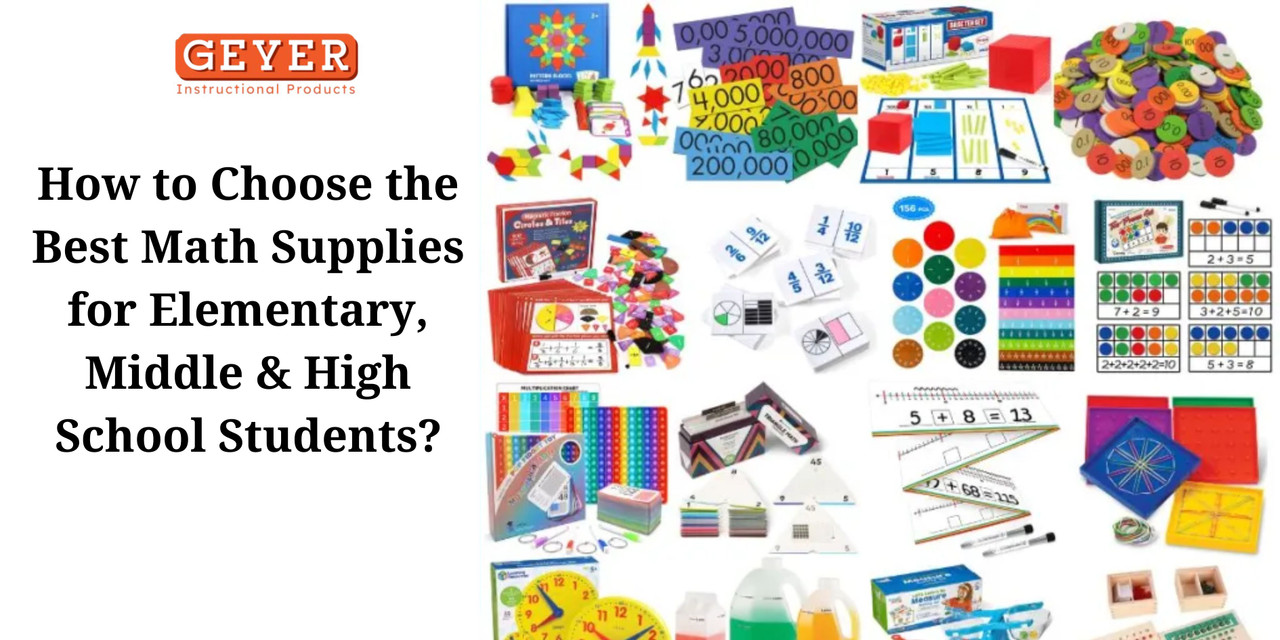
How to Choose the Best Math Supplies for Elementary, Middle & High School Students
22nd Jan 2026
Whenever we speak with teachers, one issue keeps recurring: choosing the right math supplies is not always easy. New challenges arise with each grade level, as the strategy used for third graders won't be effective for teaching calculus at the high school level. We have been a trusted partner to classrooms for many years, and we have found that the best tools align with how students think and work with numbers at different ages.
When kids grow, their math learning changes. The same goes for the tools they need.
Why Do Math Supply Needs Change as Students Grow?
Imagine a kindergarten student who has just started learning to count. He can only see and feel the digits with the help of fingers, blocks, or toy animals. The learning process at this stage is very much hands-on and straightforward.
By middle school, students connect those physical models to abstract concepts.
High school goes even deeper into abstraction. Students deal with fields, theorems, and intricate plots. Hence, they need tools that demonstrate abstract relationships.
It's not a case of doing away with what was previously there, rather it is a way of continuing to build upon it.
What happens when supplies do not match grade level?
When tools do not align with the learning stage, it leads to everyone's struggles. The mismatch in math tools leads to confusion, and student disengagement follows. Teachers end up compensating instead of the supplies supporting their instruction.
What math supplies work best for elementary students?
Kids learning math have to do it by their sense of touch before they can understand it on paper. For example, if a second grader uses ten base-ten blocks to physically group up to make 100, he or she is developing a sense of numbers, which cannot be done through a worksheet.
Among the fundamental supplies are the following:
- Manipulatives such as counting objects and pattern blocks
- Base-ten models for visualizing place value
- Number lines for sequential counting
- Fraction tiles and bars
What role do visual models play in early problem-solving?
Visual models connect physical things and the concept of abstract thinking. Number lines illustrate the relationship between numbers. Fraction tiles clarify why ½ is equal to 2/4 by means of logic, not memory.
These models enable the students to verbalize their thought process. This is the comprehension, not merely the answering.
What are the important factors that teachers should consider?
- Durability is the main concern. Elementary tools are usually dropped and put into desks. They should last through the daily usage at school.
- Organization is the most important factor. If the supplies are hard to share or clean up, they will not be used.
- Flexibility is the price saver. The top manipulatives apply to various concepts.
We have always maintained a policy of selecting classroom-tested supplies designed for real-world use, not just for demonstration.
What Is the Role of Math Tools in Supporting Deeper Understanding?
Middle school is the transition period. Children transition from "I can see it" to "I can represent it." At this point, mathematics resources become more advanced, but still with visual support.
They tackle ratios, proportions, and early algebra. They need aids that can help them detect patterns and connections.
What tools help students make conceptual connections?
- Coordinate grids are definitely among the required supplies. The students acquire skills in point plotting, line graphing, and function understanding.
- Algebra tiles are the ones that link the two realms of arithmetic and algebraic thinking. The students engage in physical activity by manipulating tiles to draw the solution to the equation x + 3 = 7, and realize that x = 4.
- Fraction and decimal models are a great help for the students to learn about equivalence.
In what ways could the right tools contribute to the improvement of math confidence in students?
Most middle school students consider themselves "not math people." But proper supplies can do wonders.
When devices diminish fear and promote experimentation, kids respond differently. They will be more likely to try, fail, and then come up with their reasoning to discuss.
Instruments designed for collaborative math learning facilitate group work.
Understanding, not absorption, is the channel through which confidence grows.
What Math Supplies Are Most Effective for High School Classrooms?
Why is precision so important?
In geometry, a 2-degree error changes the entire proof. In trigonometry, imprecise measurements lead to wrong conclusions. High school math requires precision.
What are the supporting tools for the advanced concepts?
- Graphing tools become indispensable. Students must be able to accurately depict complicated functions.
- Geometry models are good for spatial reasoning.
- Measuring tools are used in physics and advanced math classes. Protractors, compasses, and rulers are all precision instruments.
In what way do tangible tools still have importance in the upper grades?
Tangible tools help in the development of spatial reasoning. They also support the students who do not learn best through the use of screens. Not all students have the same learning style. The use of physical math materials makes sure that you are able to reach all learners.
What are the criteria to consider when selecting mathematics supplies?
How much do the durability and the convenience of the classroom matter?
Think about:
- The daily usage and the consequent wear and tear
- The storage and the organization
- The value over the years
We have always curated essential tools for the teachers that can be used the next year as well.
Should mathematics tools follow the curriculum standards?
Yes, but not strictly. The best supplies do support the core ideas consistently. They are in line with the standards without being affected by the changes in requirements.
In what ways do the versatile tools cut down on time and budget?
The use of one excellent tool can help in teaching several concepts. The coordinate grids can be used for graphing, geometry, and data analysis. The smart choices mean buying less and teaching more at the same time.
Building Robust Math Foundations at Each Grade Level
Mathematics materials are not just additional items. They are teaching aids that directly improve students' comprehension.
It has always been our objective to support teachers by selecting math tools wisely. Good understanding, confidence building, and long-term success are all made possible when we use the right tools. The smartest investment is not the one made in the largest quantities of supplies, but in the right supplies that fit students and classroom realities.
FAQs
How many math manipulatives does a classroom really need?
Quality beats quantity. Five well-chosen manipulative sets used regularly outperform twenty sets gathering dust in cabinets.
Are hands-on tools still useful with digital learning?
Absolutely. They complement technology rather than compete with it. Blended learning environments benefit from both approaches.
How can math supplies support different learning styles?
Visual learners need models and diagrams. Tactile learners benefit from manipulatives. Collaborative learners thrive with supplies designed for group work.
 Recently Viewed