
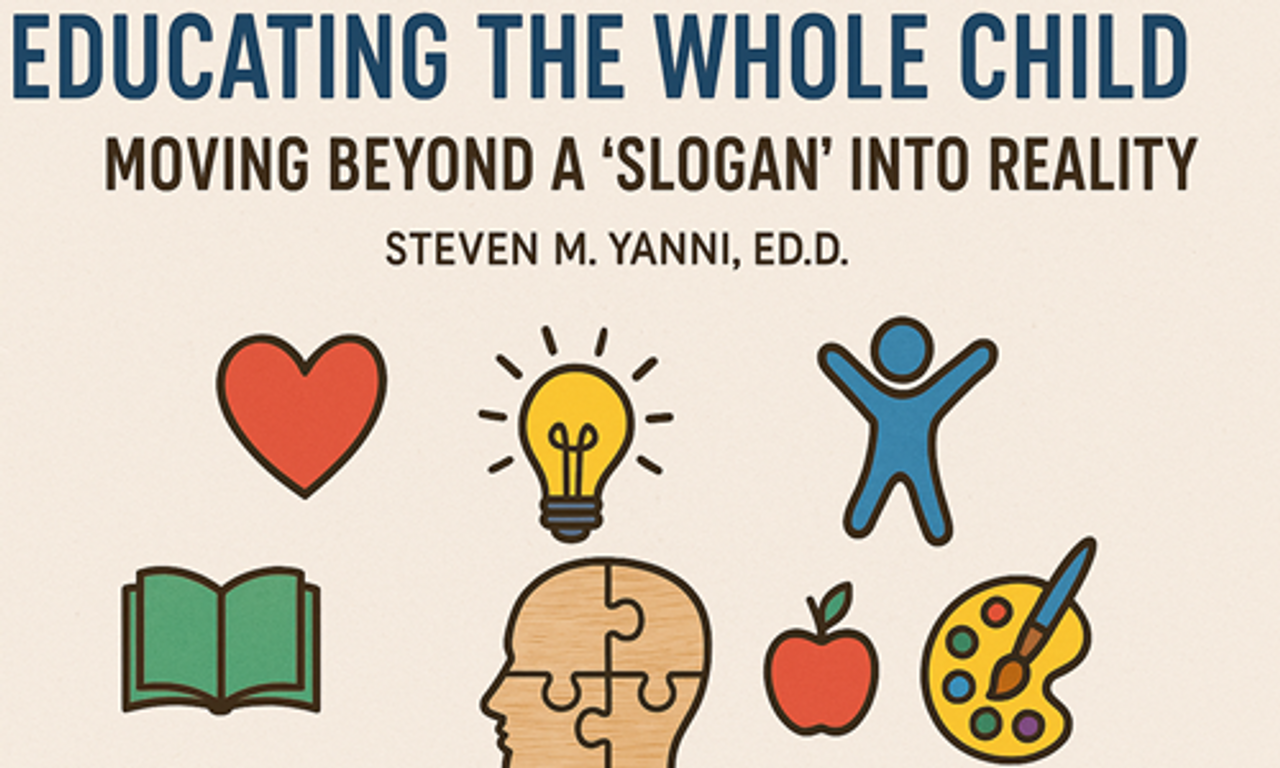
Educating the Whole Child: Moving Beyond and “Slogan” into Reality
Posted by Steven M. Yanni, Ed.D. on 16th Sep 2025
Introduction
“Educating the whole child” is more than a slogan — it is a philosophy grounded in developmental science and equity. The Whole Child approach recognizes that children cannot learn effectively if their basic needs, social belonging, and sense of purpose are ignored. It calls for schools to focus not only on academic achievement, but also on the social, emotional, physical, cultural, and civic dimensions of development.
As the ASCD Whole Child Initiative (2020) outlines, every child should be healthy, safe, engaged, supported, and challenged. Recent studies in neuroscience, psychology, and education reinforce that learning is most effective when all these dimensions are nurtured (Darling-Hammond et al., 2019; Osher et al., 2020).
Moving Beyond Academics
For decades, the measure of “success” in schools has been reduced to test scores. While accountability systems have drawn attention to achievement gaps, they have also narrowed curriculum and sidelined nonacademic development.
Research insight
- Darling-Hammond et al. (2019) show that academic learning is inseparable from social, emotional, and physical contexts.
- Mahfouz et al. (2021) found that after COVID-19 disruptions, schools that broadened definitions of success beyond test scores reported stronger recovery in engagement and mental health.
Practical strategies
- Pair achievement data with school climate surveys and SEL benchmarks.
- Use “whole-child report cards” that reflect academic growth, collaboration, creativity, and civic engagement (Feldman, 2019).
- Include family and student voice in defining what “success” means in their community.
The Core Dimensions of Whole-Child Education
- Academic Mastery
Academic learning remains a cornerstone, but mastery is about depth, transfer, and critical thinking, not mere coverage.
Research insight
-
-
- Mehta & Fine (2019) show that deeper learning environments, where students work on authentic, complex problems, foster higher achievement.
-
-
-
- Competency-based models allow students to progress at their own pace, leading to stronger mastery and equity outcomes (Sturgis, 2020).
-
Examples
-
-
- A biology unit where students design a conservation plan for a local park.
- Cross-disciplinary projects linking history of industrialization with physics of machines.
-
- Social and Emotional Learning (SEL)
SEL equips students with skills for self-awareness, empathy, and collaboration.
Research insight
-
-
- A meta-analysis of 82 SEL programs found improvements in academics (+11 percentile points), behavior, and long-term well-being (Durlak et al., 2017).
- Post-pandemic studies confirm SEL programs buffer against anxiety and depression while improving school engagement (Jones, Brush, et al., 2021).
-
Examples
-
-
- Morning check-ins or circles to build community.
- Embedding SEL in academics, e.g., analyzing empathy in a novel.
- Restorative practices in place of punitive discipline (Gregory et al., 2016).
-
- Physical Health and Well-Being
Healthy students are better learners. Nutrition, physical activity, and health services are non negotiable for equity.
Research insight
-
-
- Regular physical activity boosts executive function and academic performance (Singh et al., 2019).
- School nutrition programs improve attendance and achievement (Gordon & Ruffini, 2021).
- CDC’s Whole School, Whole Community, Whole Child (2021) model integrates health services, wellness, and safety into the education system.
-
Examples
-
-
- School gardens and farm-to-school meal programs.
- Integrating movement into lessons (e.g., kinesthetic math).
- On-site mental health counseling or partnerships with local clinics.
-
- Identity and Belonging
A sense of belonging drives motivation and resilience. Students must feel affirmed in who they are.
Research insight
-
-
- Booker (2018) shows school belonging strongly predicts persistence for students of color.
- Culturally responsive pedagogy improves both engagement and achievement(Hammond, 2015; Ladson-Billings, 2021). • Affirming environments reduce bullying and improve well-being for LGBTQ+ youth (Kosciw et al., 2022).
-
Examples
-
-
- Using diverse texts and culturally relevant examples in instruction.
- Creating affinity groups and GSAs to support marginalized identities.
- Advisory programs where each student has a trusted adult advocate.
-
- Civic and Ethical Development
Whole-child education prepares students for democracy and ethical decision-making, not just careers.
Research insight
-
-
- Civic learning opportunities increase students’ likelihood of voting and volunteering (Kahne & Sporte, 2008; Levine & Kawashima-Ginsberg, 2017).
-
-
-
- Civic education also builds critical media literacy and collaborative problem-solving (Mirra & Garcia, 2020).
-
Examples
-
-
- Service learning tied to curriculum, e.g., researching food insecurity while volunteering at food banks.
-
-
-
- Simulations like Model UN or mock trials.
- Discussing ethical dilemmas across disciplines, from AI in science to justice in literature.
-
Why It Matters
Whole-child education leads to stronger outcomes across domains.
Research insight
-
-
- SEL programs have long-term benefits including higher graduation rates and lower rates of substance abuse (Taylor et al., 2017).
-
-
-
- Whole-child approaches improve teacher retention and student engagement (Darling Hammond et al., 2020).
-
-
-
- Students with strong sense of belonging and health supports outperform peersacademically (Osher et al., 2020).
-
A Practical Vision in Schools
Whole-child education is a lens for school design and culture, not an add-on program.
Examples of implementation
- A K–8 school combines SEL check-ins, arobust arts program, and PBL units that link science and service.
References
ASCD. (2020). The Whole Child approach.
Battelle for Kids. (2021). Portrait of a Graduate Framework.
- A high school builds advisory systems, integrates health partnerships, and
connects civic projects to core curriculum. • A district adopts a “Portrait of a Graduate” framework that articulates competencies like collaboration, empathy, and civic
responsibility (Battelle for Kids, 2021).
Conclusion
To educate the whole child is to affirm that students are multidimensional human beings whose learning and flourishing depend on the integration of academic, social, emotional, physical, cultural, and civic development. Schools that embrace this vision not only raise test scores but prepare resilient, ethical, and engaged citizens ready to shape the future.
Booker, K. C. (2018). Belonging matters: African American adolescents and school belonging. Urban Education, 53(1), 97–123.
CDC. (2021). Whole School, Whole Community, Whole Child (WSCC) Model.
Darling-Hammond, L., Flook, L., Cook-Harvey, C., Barron, B., & Osher, D. (2019). Implications for educational practice of the science of learning and development. Applied Developmental Science, 24(2), 97–140.
Darling-Hammond, L., et al. (2020). Restarting and reinventing school: Learning in the time of COVID and beyond. Learning Policy Institute.
Durlak, J. A., et al. (2017). The impact of enhancing students’ SEL: Meta-analysis of interventions. Child Development, 88(4), 1156–1171.
Feldman, J. (2019). Grading for equity. Corwin.
Gordon, N., & Ruffini, K. (2021). School nutrition and student outcomes. Journal of Policy Analysis and Management, 40(2), 473–505.
Gregory, A., Clawson, K., Davis, A., & Gerewitz, J. (2016). The promise of restorative practices to transform teacher–student relationships and achieve equity in school discipline. Journal of Educational and Psychological Consultation, 26(4), 325–353.
3
Hammond, Z. (2015). Culturally responsive teaching and the brain. Corwin.
Jones, S. M., Brush, K., et al. (2021). Navigating SEL in uncertain times. Harvard Graduate School of Education.
Kahne, J., & Sporte, S. (2008). Developing citizens: The impact of civic learning opportunities. American Educational Research Journal, 45(3), 738–766.
Kosciw, J. G., et al. (2022). The 2021 National School Climate Survey. GLSEN.
Ladson-Billings, G. (2021). Culturally relevant pedagogy: Asking a different question. Teachers College Press. Levine, P., & Kawashima-Ginsberg, K. (2017). The civically engaged classroom. Teachers College Press.
Mahfouz, J., Greenberg, M., & Rodriguez, A. (2021). Addressing student trauma during COVID-19. Journal of School Health, 91(6), 423–432.
Mehta, J., & Fine, S. (2019). In search of deeper learning. Harvard University Press.
Mirra, N., & Garcia, A. (2020). Civic literacy in a digital age. Harvard Educational Review, 90(3), 476–502.
Osher, D., Kidron, Y., et al. (2020). Advancing whole child and whole school approaches to learning. Review of Research in Education, 44(1), 142–182.
Singh, A. S., et al. (2019). Physical activity and cognitive development in childhood. British Journal of Sports Medicine, 53(14), 852–858.
Sturgis, C. (2020). The case for competency-based education. Aurora Institute.
Taylor, R. D., et al. (2017). Promoting positive youth development through SEL: Meta-analysis. Child Development, 88(4), 1156–1171.
4
 Recently Viewed