
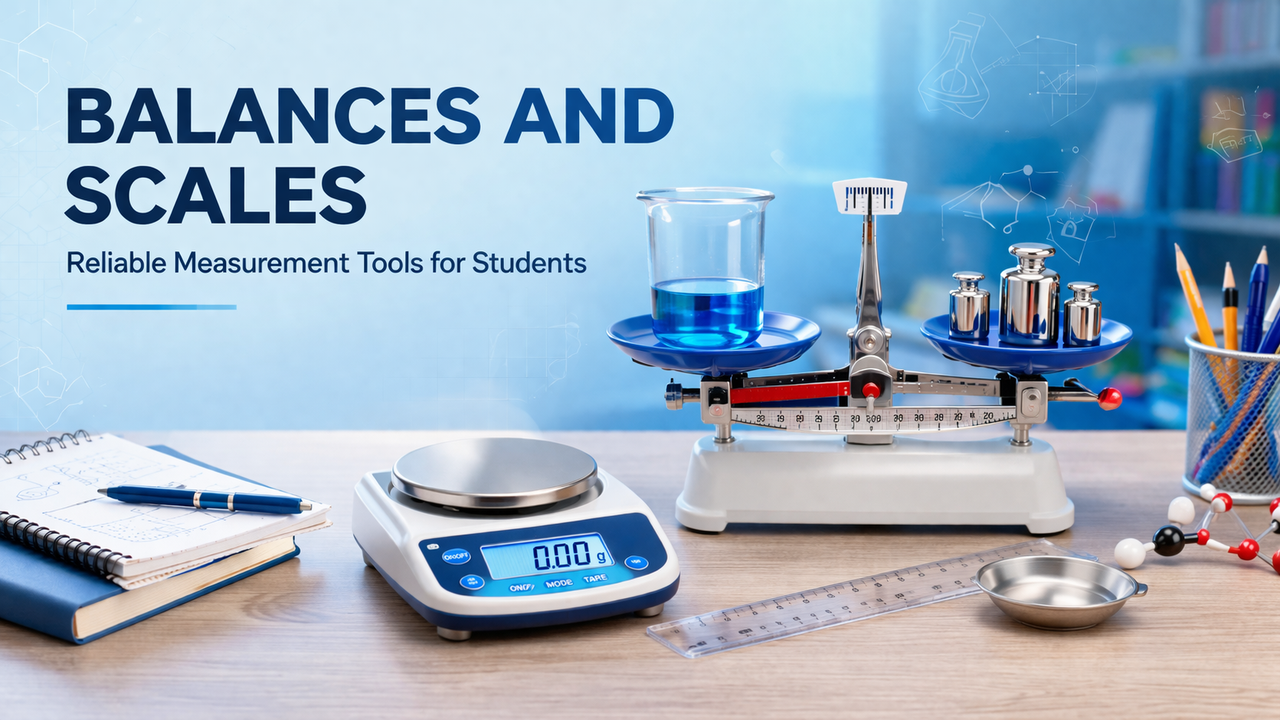
Balances and Scales: Reliable Measurement Tools for Students
31st Mar 2026
When students step into a science lab, one of the first tools they reach for is a balance and scales set. Picking the right one and using it correctly makes a real difference in lab results. We've been supplying classrooms since 1960, and one thing hasn't changed: teachers who choose the right measurement tool see students shift from guessing to actually knowing.
What Are Balances and Scales, and Why Do They Matter in Student Labs?
A balance compares the mass of two objects using a beam or pan system. A scale measures mass electronically using internal sensors. Both give students a real, reliable number instead of an estimate.
In 2026, STEM learning accuracy isn't optional. Labs ask students to collect data, write reports, and draw conclusions. That shift from approximation to quantitative accuracy is one of the most important things a student can learn in a lab.
What Is the Difference Between a Balance and a Scale in Classroom Use?
Both tools measure mass, but they suit different learning moments. We hear this question from teachers regularly, and the answer usually depends on what the lesson is actually trying to do.
When Should Students Use a Triple-Beam Balance vs. a Digital Scale?
A triple-beam balance is mechanical. The student slides weights along three beams until the pan sits level. It teaches the concept of mass through hands-on interaction. Many teachers we work with still start every new unit with one; it slows students down and makes them think.
A weighing scale (digital) shows a number instantly. Use a triple-beam balance when the goal is understanding mass as a concept. Use a digital scale when the goal is speed, precision, and data collection.
Which Is More Accurate for Modern Science Experiments?
Digital tools win on accuracy. A human reading a triple-beam balance can make small errors, especially younger students. For lab reports requiring significant figures or AP and IB-level work, a digital tool is the safer choice.
|
Feature |
Triple-Beam Balance |
Digital Classroom Scale |
|
Learning Goal |
Conceptual understanding |
Fast, precise measurement |
|
Accuracy |
Depends on the user reading |
Objective digital output |
|
Setup Time |
Manual zeroing required |
Instant tare function |
|
Durability |
Very high |
High with protection features |
|
Power |
None |
Battery or adapter |
How Do You Choose the Right Scale for Student Experiments?
This is where most purchasing mistakes happen. Teachers often pick a tool based on price alone, without checking whether the precision actually matches the curriculum.
What Is "Readability" and Why Does It Matter?
Readability (written as "d") is the smallest unit a scale can measure accurately. For general physics and earth science, 0.1g is fine. Chemistry work typically needs 0.01g. Advanced or AP-level chemistry may require 0.001g.
How Much Precision Do Students Actually Need?
Match the tool to the curriculum. Elementary students do well with spring scales or bucket balances. Middle schoolers typically need a 0.1g digital scale or a triple-beam balance. High school chemistry generally needs 0.01g or better. Buying a tool that's too precise wastes budget. Buying one that's not precise enough produces bad data.
How Do Digital Classroom Scales Actually Work?
What Is Strain Gauge Technology in Simple Terms?
A strain gauge is a small sensor inside a digital scale. When you place an object on the pan, the platform bends slightly. The strain gauge turns that bend into an electrical signal, which becomes the number on the screen. It responds the same way every time, regardless of where you place the object on the pan.
Why Does This Matter for Student Accuracy?
Students don't always place objects in the center of the pan; that's just classroom reality. A weighing balance without good sensor design gives different readings depending on placement. A well-made scale removes that variable, so students can trust what they record.
Are Classroom Scales Durable Enough for Daily Student Use?
What Is Overload Protection and Why Is It Important?
Students press down on scales; we've seen it in labs across the country. A scale without overload protection will break under that pressure. Good classroom scales have a "hard stop" that prevents the sensor from bending too far, extending the tool's life significantly. A low-profile, stackable build and removable pans that clean separately reduce wear and replacement costs over time.
How Do You Ensure Measurement Accuracy Over Time?
What Is Calibration and Why Should Students Learn It?
Calibration is checking and adjusting a scale using a known standard weight. In our experience, it's one of the most skipped steps in student labs and one of the most impactful to teach. Students who calibrate before an experiment approach their data with more confidence.
If you're building out your full lab setup, our guide Science Supplies for Teachers: A Complete Lab Setup Guide covers how measurement tools fit alongside glassware, safety equipment, and everything else a science classroom needs.
Why Is "Checking the Zero" Critical Before Every Experiment?
If a scale reads 0.3g with nothing on it, every measurement that follows will be 0.3g too high. Before every lab, students should turn the scale on, confirm it reads 0.0g with an empty pan, and press the tare button if needed. Ten seconds. Prevents errors that can throw off an entire experiment.
What Makes a Scale Safe and Reliable in Science Classrooms?
What Materials Prevent Damage from Chemicals?
Stainless steel pans resist corrosion from acids and salts; the better choice for chemistry labs. Plastic pans are suitable for general use but may warp with repeated exposure to chemicals. Teachers who've made the switch to stainless steel rarely go back.
How Do You Know a Scale Is Accurate Out of the Box?
Reliable scales go through factory linearity and repeatability testing. This means the reading is accurate across the full range, not just at one point. It also means teachers can trust the tool from day one without running their own verification tests first.
Why Are Reliable Measurement Tools Essential for Modern STEM Education?
We've supported classrooms for over 60 years, and STEM expectations have grown considerably. Students today aren't just asked to observe; they're asked to prove. A reliable weight scale gives students confidence in their numbers, and that confidence carries forward into every lab they'll ever work in.
Frequently Asked Questions
What Is the Most Accurate Scale for Students?
A digital scale with 0.01g readability covers most classroom chemistry and physics needs. For AP work, look at options with 0.001g precision.
Do Schools Still Use Triple-Beam Balances?
Yes. Many teachers we work with use both the triple-beam balance for intro lessons and a digital scale for data collection.
How Often Should Classroom Scales Be Calibrated?
At the start of each semester, at a minimum. For active chemistry classes, once a month is a good habit. Always calibrate after moving or dropping a scale.
What Is Good Readability for Middle School Labs?
A digital scale with 0.1g readability works well for most middle school experiments, including density and basic chemistry labs.
Can Digital Scales Replace Traditional Balances Completely?
Not entirely. Digital tools are faster and more precise, but traditional balances build conceptual understanding that a screen readout doesn't. Most well-equipped labs benefit from having both.
 Recently Viewed