
The Ultimate Guide to Graph Paper: Types and Uses
20th Feb 2026
Graph paper has been a classroom staple for decades, and we have confirmed its ongoing necessity through our classroom experience. The correct paper selection helps students better understand their work, according to our experience teaching thousands of students. The guide provides information on the different graph types available, along with their appropriate uses and guidelines for making proper selections.
Why Does Graph Paper Still Matter in Today's Math Classrooms?
We've been supporting teachers since 1960, and one thing hasn't changed: students need visual structure to organize their mathematical thinking. Graph paper isn't just a worksheet accessory. It's a thinking aid that helps students line up numbers, plot points accurately, and see patterns.
Before choosing the right paper, you need to understand what each type does.
What Is Graph Paper Really Designed to Do?
Think of graph paper with a grid as a visual scaffold. It creates a structure where students might otherwise get lost. We've watched students struggle; not because they didn't understand the math, but because their numbers drifted across blank paper.
Different grids serve different needs. A student graphing linear equations needs different support than one sketching 3D shapes.
Let's start with square grids.
When Should You Use Standard Square Graph Paper?
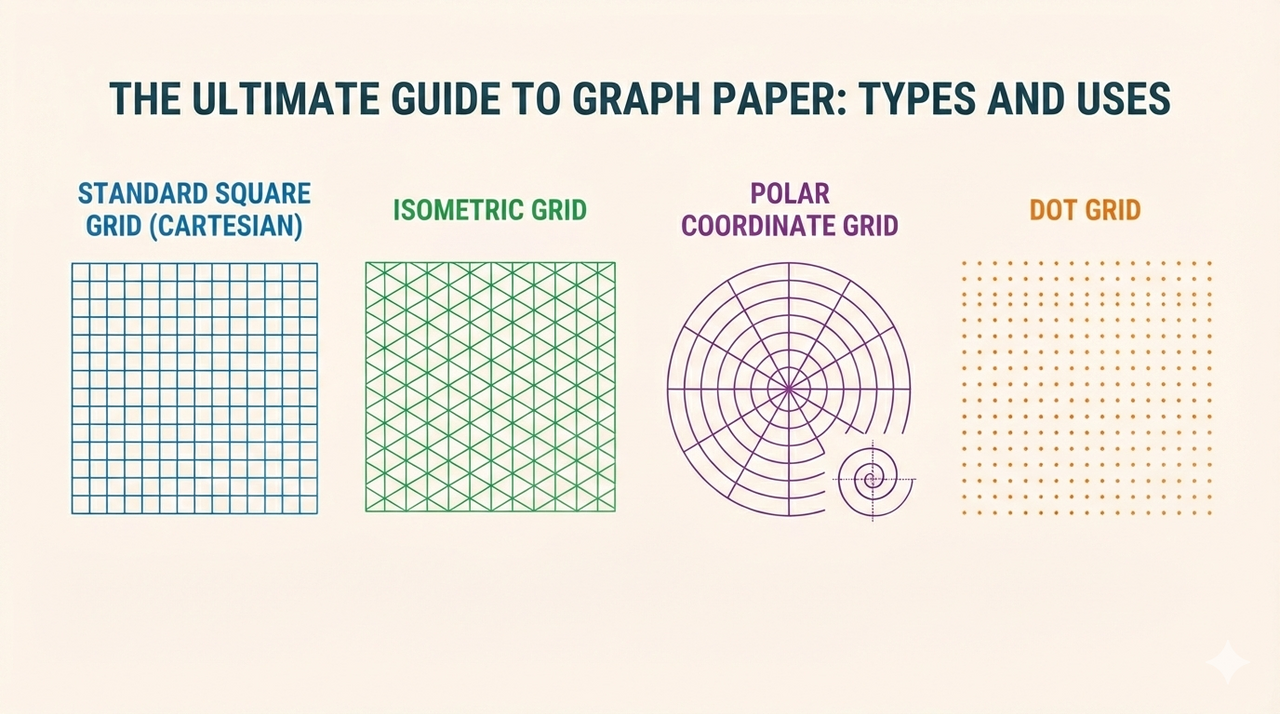
Classic graph paper with square grids is where most math students begin. It works for arithmetic, algebra, coordinate graphing, and data tables.
How Do Grid Sizes Like 1/4", 1/2", and 1 cm Change Student Accuracy?
Grid size directly impacts how well students work. Smaller grids (1/4 inch) work well for older students. Larger grids (1/2 inch or 1 cm) give younger learners room to write clearly.
We've seen middle schoolers struggle with decimals simply because their grid was too small. Numbers overlapped, creating errors unrelated to understanding. Switching to 1/2 inch grids improved their accuracy immediately.
Paper quality matters too. Crisp lines help students count squares quickly. Thin paper causes bleed-through and visual confusion.
Why Is Isometric Graph Paper Essential for 3D Thinking?
Squared paper works beautifully for two dimensions. But when students work with volume or engineering concepts, they need to visualize depth.
How Does Isometric Paper Help Students Visualize Depth?
Isometric paper uses a 60-degree grid pattern instead of 90-degree squares. Students can sketch cubes and prisms without learning complicated perspective drawing.
In STEM classrooms, students use isometric paper to design structures and understand spatial relationships. One teacher told us her students finally "got" volume after sketching on isometric grids.
This strengthens spatial reasoning for architecture, engineering, and design fields.
What Makes Polar Graph Paper Different From Cartesian Grids?
Grid paper typically means horizontal and vertical lines. A polar graph sheet uses concentric circles and radiating lines to map points based on distance and angle.
Why Do Trigonometry Students Learn Faster With Polar Grids?
Polar coordinates feel confusing on standard graph paper. Students convert angles and distances into x and y coordinates; extra steps are unrelated to the actual concept.
Trigonometry teachers tell us that polar grids cut setup time in half. Students plot points directly. One teacher described an "aha moment" when her class realized how much simpler graphs have become.
How Does Graph Paper Support Data, Statistics, and Trends?
Graph sheet formats go beyond basic grids. Real-world data often needs specialized paper for different scales or growth patterns.
When Are Logarithmic or Specialized Grids the Right Choice?
Logarithmic graph paper helps students visualize exponential growth or data spanning multiple magnitudes. Think population growth or bacterial cultures. Regular graph paper compresses these patterns beyond recognition.
Students use semi-log paper to linearize exponential data, making trends easier to identify. This connects to Common Core standards for interpreting functions.
Formats for Every Classroom Need
Graph Stickers: Perfect for interactive notebooks, exit tickets, or adding a grid to a test/quiz without reformatting the whole page.
Graphing 3M Post-it® Notes: Ideal for quick teacher feedback; if a student misses a concept, stick a grid right on their work for a "do-over" or a correction.
8.5" x 11" Reams: The high-volume staple for homework and testing. (Best sellers include 150054 and 150056).
How Do You Choose the Right Graph Paper for Each Grade Level?
Match the grid to students' developmental stage and learning concepts.
A Simple Graph Paper Selection Matrix for Teachers
Quick reference:
- Everyday Math: Classic ($1/4$", $1/8$")
- Intervention/Lower Grades: Accentuated
- Science/STEM Labs: Metric or Decimal
- Functions/Coordinate Geometry: XY Axis or 4-Quadrant
- Trigonometry: Radian or Polar
- Design/Drafting: Isometric or 3-D Axis
- Quick Assessments: Half-sheets or Stickers
|
Paper Type |
Best For... |
Why It Works |
|
XY / Four-Quadrant |
Algebra & Pre-Calc |
Pre-printed axes save time and ensure students focus on the math, not drawing lines. |
|
Multi-Grid (2, 3, 4, 6) |
Worksheets & Practice |
Allows students to complete multiple problems on one sheet; a favorite for assessments. |
|
Decimal / Metric |
Science & STEM Labs |
Aligns with base-10 scaling and international measurement standards. |
|
Accentuated |
Younger Learners |
Bold lines every few squares make counting intervals much easier for beginners. |
|
Radian / Polar |
Trig & Calculus |
Essential for unit circle work and wave patterns in Physics. |
|
3-D Axis |
Modeling & Calc |
Allows for plotting 3D points and visualizing surfaces in higher-level math. |
For broader guidance on math supplies across grade levels, check out our guide on How to Choose the Best Math Supplies for Elementary, Middle & High School Students.
Why the Right Graph Paper Makes Math Feel Possible
We've spent decades watching students work with graph-ruled paper. The right type shifts students' entire relationship with math. What felt impossible becomes manageable with proper visual structure.
Graph-lined paper makes mathematical thinking visible. When students see their thinking clearly, confidence grows. That confidence transforms students from struggling to understanding.
The Geyer Difference: Why Red Ink Matters
Most graph paper uses blue or black lines, which can camouflage a student's pencil marks. We offer graph paper in Red Ink specifically to create a distinct visual contrast. This allows teachers to see the student's work instantly and helps students avoid losing their place in a sea of grey graphite.
Common Graph Paper Questions Teachers Ask
Why is some of your paper printed in red?
Red ink provides a sharp contrast against pencil marks, making it easier for both students and teachers to read the plotted data.
What grid size works best for struggling students?
Larger grids provide better scaffolding. Start with 1/2 inch grids and move to smaller ones as confidence builds.
Does graph paper support Common Core standards?
Yes. It supports standards for coordinate planes, geometric measurement, and data interpretation.
How should graph paper be stored?
Keep it flat and dry. Store reams horizontally to prevent curling.
Do you offer printable options?
No, we focus on high-quality, professionally printed physical products that ensure measurement precision and provide unique tools like stickers and Post-it notes that a standard printer cannot replicate.
 Recently Viewed