The Boring Supplies Nobody Budgets For (Until the Lab Stops)
29th Sep 2026
A new microscope shows up in a budget proposal every year. Lens paper never does. That gap is the real reason lab periods stall, not the equipment itself. A $300 microscope and a few sheets of lens paper cost less together than one ruined week of rescheduled labs.
We've sat in on enough supply orders to notice a pattern. Departments plan carefully for the big purchase, then run out of the small parts that make the big purchase usable. This piece walks through why that happens and what to check before it happens to you.
Why Do Science Labs Stall Even When the Equipment Budget Is Fully Spent?
Labs stall because the failure point is rarely the machine. It's the small part that keeps the machine running day to day.
Every department has two shopping lists. One is exciting: microscopes, hot plates and digital balances. The others are easy to forget: lens paper, stoppers, boiling chips, and calibration weights. The second list is what actually breaks a lab period when it runs dry.
| Category | "Exciting" Budget Line Items | "Boring" Operational Essentials |
|---|---|---|
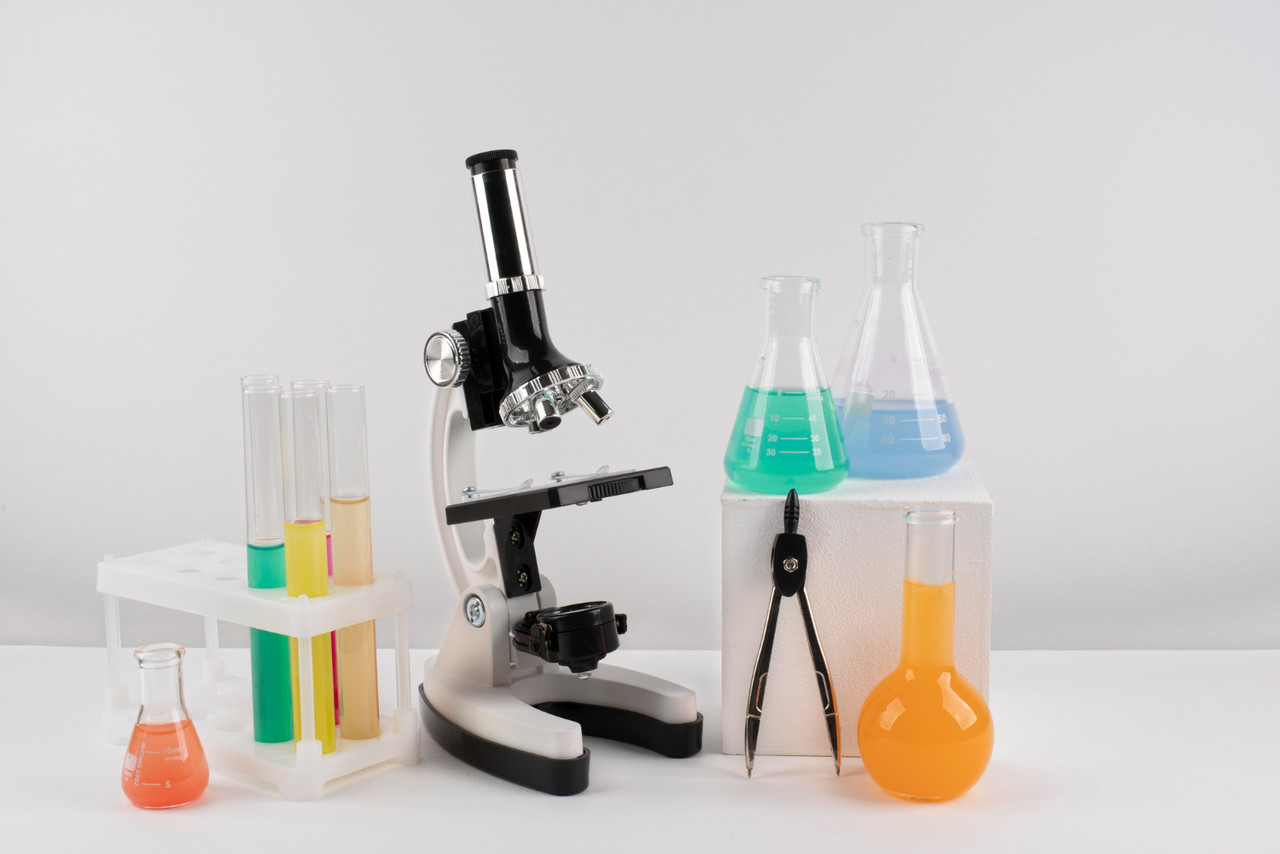
| Microscopy | Compound and stereo digital microscopes | Lens cleaning paper, immersion oil, slide cover slips, pre-cleaned slides |
| Chemistry and Biology | Beakers, Erlenmeyer flasks, hot plates | Rubber stoppers, boiling chips, transfer pipettes, wash bottles |
| Safety and Hygiene | Eyewash stations, chemical safety cabinets | Sanitation cabinet bulbs, spill neutralizing powder, apron ties |
| Measurement and Physics | Spring scales, motion sensors, digital balances | Calibration weights, replacement lead wires, alligator clips, masking tape |
Look at that right-hand column again. None of it shows up in a ribbon-cutting photo. All of it decides whether Tuesday's lab actually happens.
What Actually Happens When a Lab Runs Out of the Boring Stuff?
One missing consumable, not one missing machine, is usually what cancels a lab period.
Here's the sequence we see most often:
High-ticket equipment gets purchased → a matching consumable runs out → the lab period gets cut or cancelled → the department pays for emergency freight to fix it fast.
That last step is where the real cost hides. A few things worth knowing:
- Wasted instructional time. A 45-minute chemistry lab gets cancelled because there's no matching rubber stopper for the gas collection setup, and curriculum pacing takes the hit.
- Premature equipment damage. Wiping a delicate lens with a paper towel instead of proper lens paper can scratch the anti-reflective coating, causing lasting damage to the optics.
- Emergency shipping fees. A $15 box of replacement fuses ordered on overnight delivery often costs more in freight than the part itself.
None of these show up as a single dramatic failure. They show up as a slow leak in the budget that's harder to trace than a broken piece of equipment.
Which Consumables Run Out First in a Working Science Department?
Four categories cause most of the mid-semester scrambles we hear about from department heads.
- Lens cleaning paper and immersion oil. These protect microscope optics from oil buildup and scratch damage, and they run out faster than anyone expects once a class actually starts using scopes daily.
- Assorted rubber and cork stoppers. Stocking solid, one-hole, and two-hole sizes keeps standard flask and test tube setups sealed without air leaks.
- Disposable transfer pipettes and test tube brushes.These are high-turnover items, and reusing or inadequately cleaning them when supplies run low raises the risk of cross-contamination in a biology or chemistry lab.
- Sanitation cabinet UV bulbs. A goggle sanitizing cabinet only works if the internal bulb is actually putting out full UV output, and that bulb fades long before it visibly fails.
This is the same instinct behind packing a good bag for the day-to-day grind. We wrote about that idea from a different angle in The Teacher's Loadout: What's Actually in a Great Teacher's Bag, where the unglamorous items in a teacher's bag do more daily work than the flashy ones. The same logic runs straight through a science department's supply closet.
Chemistry departments feel this list is the hardest. Anyone stocking a wet lab knows that chemical laboratory supplies don't fail all at once. They thin out quietly, one dropper and one stopper at a time, until a lab prep day turns into a scramble.
How Do You Audit Lab Supplies Before They Run Out?
A 60-day pre-semester check catches shortages before they land in the middle of a lesson plan. Here's the sequence we walk departments through.
Phase 1: Optics and Glassware Check
Count blank slides, cover slips, and lens paper booklets. Inspect test tubes and any laboratory flask on the shelf for chips or cracks that need to be pulled and replaced before day one.
Phase 2: Hardware and Stopper Audit
Sort rubber stoppers by size number, test alligator clip spring tension, and restock boiling chips for heat experiments. This is the phase most departments skip, and it's the one that causes the most mid-semester stoppages.
Phase 3: Safety Cabinet Test
Turn on goggle sanitation cabinets to confirm the UV light is actually working, not just powered on, and check the shelf life on chemical spill neutralizers.
Phase 4: Bulk Buffer Ordering
Consolidate small consumable needs across biology, chemistry, and physics into a single bulk order. Separate small orders rack up shipping fees that quietly outpace the cost of the supplies themselves.
Budgeting for science isn't just about buying the big machines. It's about buying enough small, disposable parts to keep those machines working every single period.
What Does the Research Say About Underfunded Science Labs?
This isn't just a supply closet complaint. NSTA's survey of science educators found that consumable lab supplies were the most commonly purchased item by teachers, and that 63% of respondents had dropped a planned lab at least once in a year because of budget strain (NSTA, Science Educators Still Feel Budget Strain). That's not a story about missing equipment. It's a story about missing restocks.
The pattern holds across nearly every school we talk to: the big-ticket items get funded first, and the parts that keep them running get funded last, if at all.
Keeping the Boring Stuff in Stock
None of this requires a bigger budget. It requires the boring line items to get the same attention as the exciting ones, including lab chemicals like ethyl alcohol that specific procedures call for, always used and stored according to the product label and SDS.
If your chemistry department is due for a restock, we carry Aldon Chemicals Reagent Grade 95% Denatured Ethyl Alcohol, 500 mL, alongside the rest of the small, unglamorous parts that keep a lab moving. It's the kind of item that's easy to overlook until the week it's gone.
Frequently Asked Questions
How long is a meter stick?
A standard meter stick measures 100 centimeters, or roughly 39.4 inches.
How many mL is a standard lab beaker?
Classroom beakers commonly come in 50 mL, 100 mL, 250 mL, and 400 mL sizes. The right size depends on the experiment, so it's worth checking the procedure or lab manual before assuming one size fits every setup.
What size rubber stopper fits a standard test tube?
Fit depends on the test tube's diameter and the sizing system used by the stopper manufacturer, so there isn't one standard size that fits every tube. It's worth keeping a mixed-size pack on hand rather than guessing.
How do you clean a microscope lens without damaging it?
Use lens-grade paper or a lint-free cloth with a manufacturer-approved cleaning solution, never a paper towel or tissue. Wipe in a single smooth motion from center outward, and let an air blower handle loose dust first.
How often should a goggle sanitizing cabinet's UV bulb be replaced?
Replacement schedules vary by manufacturer, so check the bulb's documentation for the recommended interval. UV output can decline well before the bulb stops producing visible light, so a cabinet that looks like it's working isn't the same as one that's actually sanitizing.
 Recently Viewed