
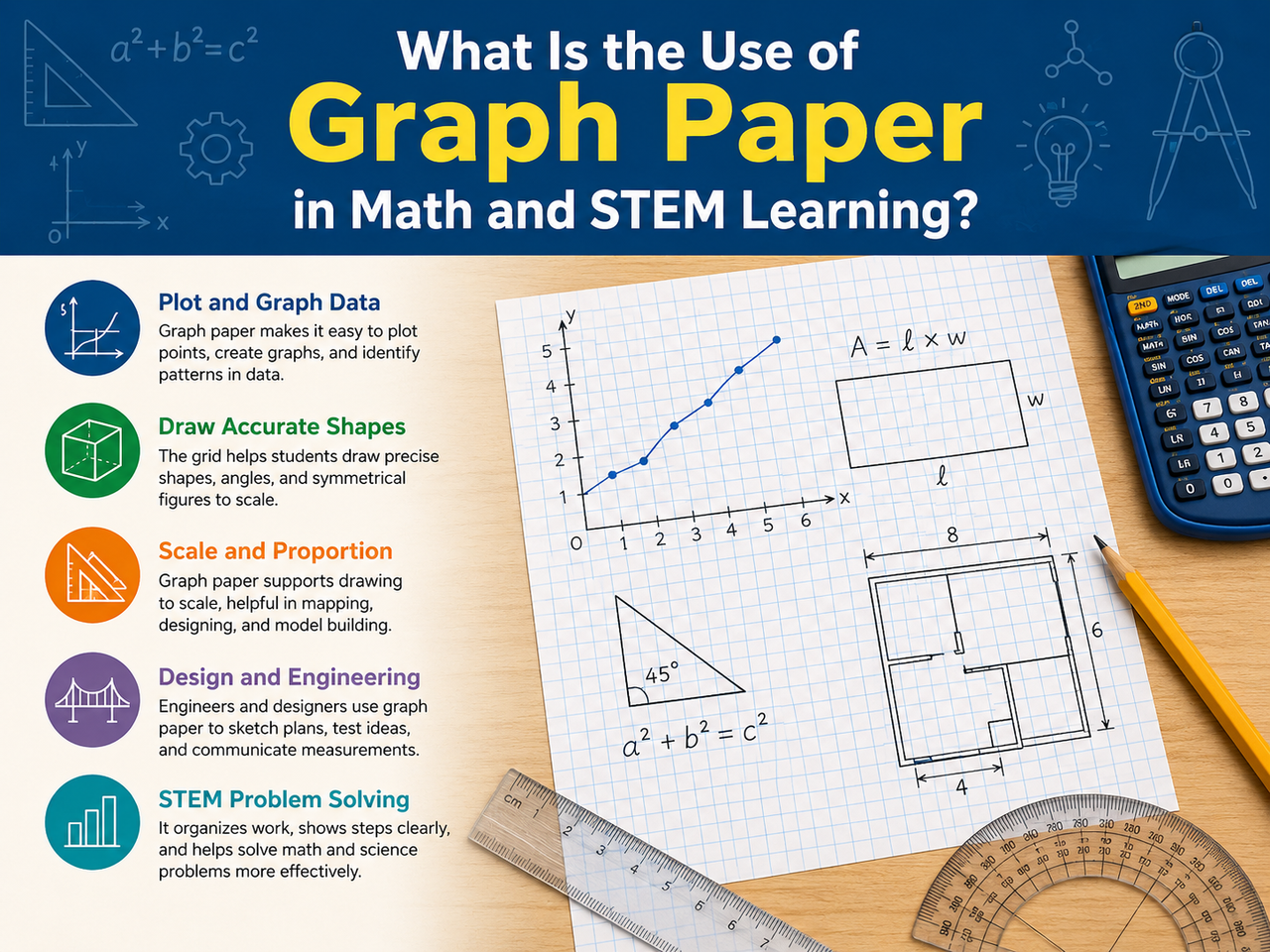
What Is the Use of Graph Paper in Math and STEM Learning?
12th Jun 2026
Graph paper helps students visualize mathematical relationships, organize data accurately, and build the spatial reasoning skills needed across STEM subjects. The use of graph paper goes far beyond plotting points; it gives students a structured framework that makes abstract concepts easier to understand and apply, from basic algebra to engineering design.
Many people think of graphing paper as a simple classroom staple. Its real value lies in how it helps students think, reason, and solve problems more effectively.
Why Does Graph Paper Make Math Easier to Understand?
How Does a Grid Reduce Cognitive Load for Students?
A blank page asks a student to manage two things at once: the math problem itself and the task of keeping numbers and figures neatly aligned. That dual burden quietly slows learning, especially for younger students.
A grid removes the second task entirely. The lines act as a ready-made scaffold, giving students a consistent visual reference so they can focus on the math. Research published in the Mathematics Education Research Journal confirms that spatial reasoning is consistently and predictively linked to math achievement and that spatial skills can be improved with practice. Grid-based work is spatial training built directly into daily classwork.
Why Do Math Teachers Still Rely on Graph Paper?
Coordinate plane paper supports day-to-day instruction in ways that are easy to overlook:
- Keeping multi-digit equations aligned so place value errors are immediately visible
- Drawing geometric figures to accurate proportions without measuring tools
- Tracking number patterns at a glance
- Organizing data tables so columns stay clean
When students work on graph paper with axis and numbers already printed, they spend less time setting up and more time solving.
How Does Graph Paper Help Students Visualize Mathematical Concepts?
Why Is Graph Paper Important for Algebra and Coordinate Geometry?
The jump from arithmetic to algebra is one of the biggest conceptual leaps in a student's education. Graph paper bridges that gap. When a student plots a linear equation, they stop seeing it as a string of symbols and start seeing it as a physical line with direction and slope.
With pre-printed axes, students can plot ordered pairs, compare two functions side by side, watch slope change as they adjust coefficients, and find intersections visually. That shift from symbol to picture is what makes abstract notation concrete.
How Does the Grid Turn Abstract Math Into Something Students Can See?
A student graphing a parabola on grid paper can watch the curve widen or narrow as values change. The relationship becomes visual, not just mechanical. The same applies to geometric transformations: when a student reflects a triangle across the y-axis, they count squares instead of guessing. The grid keeps the transformation accurate and the concept memorable.
What Role Does Graph Paper Play in Modern STEM Education?
Why Is Graph Paper Often the First Step Before Technology?
Most articles about graph paper focus on graphing equations. What gets overlooked is what graph paper does before students open a laptop or design app.
When students jump straight into CAD software or robotics platforms, they often struggle because they haven't reconciled dimensions in their minds first. Working through a design on isometric or centimeter grid paper forces reconciliation on paper. Students who sketch designs before building are better prepared because they've already resolved measurement conflicts and proportions before touching any physical materials.
This tactile-to-tech approach is easy to skip and consistently worth keeping.
How Do Students Use Graph Paper During Engineering and Robotics Projects?
In robotics and engineering courses, graphing paper supports nearly every stage:
- Planning robot course maps and programming coordinates
- Sketching bridge or structure designs to scale
- Mapping gear placement and calculating gear ratios
- Creating prototype layouts before cutting or assembling
Physical sketching remains a core part of idea generation in STEM design thinking. A precise grid keeps those sketches proportionally honest from the start.
Which Type of Graph Paper Should You Use for Different STEM Activities?
How Do You Choose the Right Grid for the Task?
The grid format should match the task. Here's a straightforward comparison:
|
Grid Type |
Math or STEM Application |
Key Learning Benefit |
|
Standard Square (1/4" or 1/2") |
Geometry, area and perimeter |
Simplifies counting units and maintaining scale |
|
Centimeter Grid |
Science labs and metric measurements |
Aligns with metric-based experiments |
|
Isometric Grid |
Engineering, architecture, 3D design |
Supports accurate 3D visualization |
|
Polar Coordinate Paper |
Physics, trigonometry, calculus |
Useful for circular and angular relationships |
|
Coordinate Plane Paper |
Algebra and graphing functions |
Provides ready-to-use axes for accurate plotting |
Printable graph paper works well for practice and one-off lab activities. For repeated classroom use, heavier graph paper print holds up better under erasing. Always verify that the graph paper scale matches your curriculum, especially for metric lab work where a near-centimeter grid introduces real measurement error.
How Does Graph Paper Teach Scale, Precision, and Real-World Measurement?
Why Is Understanding Scale Important in STEM?
One square can represent 1 inch, 1 meter, or 1 micron depending on the assignment. Learning to define and apply a scale factor is foundational across every STEM field. A scale error in an engineering sketch produces a physical build that doesn't match its intended dimensions. The grid teaches students to treat scale seriously from the beginning.
How Does Graph Paper Improve Accuracy and Error Detection?
Graph paper helps students catch their own mistakes. When a data point lands half a square off, the visual break is immediately obvious. A misaligned column breaks the grid's rhythm and catches the eye before the error compounds. In lab work especially, that self-correction dynamic is valuable. Students check their data rather than accept it and move on.
Why Does the Quality of Graph Paper Matter in the Classroom?
What Should Educators Look for When Choosing Graph Paper?
When selecting graphing paper for classroom use, these factors matter:
- Consistent grid calibration across every sheet
- Clear line weight that doesn't overpower student work
- Paper stock heavy enough to handle erasing without tearing
- Printing accuracy, especially for metric grids in lab work
At Geyer, educators rely on precision-calibrated formats because accurate grids directly affect the reliability of student work in math, science, and engineering. You can explore coordinate plane paper, metric grids, and specialty formats in Geyer's math resources catalog.
Conclusion: Is Graph Paper Still Relevant in a Digital STEM Classroom?
The biggest misconception is that graph paper is just for plotting points.
It builds spatial reasoning, supports mathematical modeling, strengthens design thinking, and connects abstract concepts to physical space. Even in technology-rich classrooms, it remains one of the most effective tools for building foundational STEM understanding before students move into advanced digital platforms.
The grid is simple. What it teaches is not.
Frequently Asked Questions About Graph Paper
What Is Graph Paper Used For?
Graph paper is used for plotting functions, drawing geometric figures, recording scientific data, designing prototypes, and creating scale drawings. It supports learning across math, science, architecture, and STEM at every grade level.
How to Use Graphing Paper?
Define your scale first (what each square represents), then label your axes. Plot data points using the grid lines to maintain accuracy, and connect points only after all data is recorded.
How to Write in Graph Paper Neatly?
Write one digit per square, align equations vertically using the grid, and work in pencil so corrections stay clean. Use the margins outside the grid for labels and notes.
What Is the Difference Between Graph Paper and Grid Paper Interactive Tools?
Physical graph paper is tactile and low-distraction, ideal for building foundational skills. Grid paper interactive tools offer features like auto-scaling and data import but work best once students already understand the core concepts from hands-on practice.
Where Can You Buy High-Quality Graph Paper for Classrooms and STEM Programs?
Specialized formats, including printable graph paper, coordinate plane paper, metric grids, and isometric grids, are available through Geyer Instructional's math and graphing catalog. Geyer has supplied schools and STEM programs since 1960 with formats matched to specific curriculum needs.
 Recently Viewed