

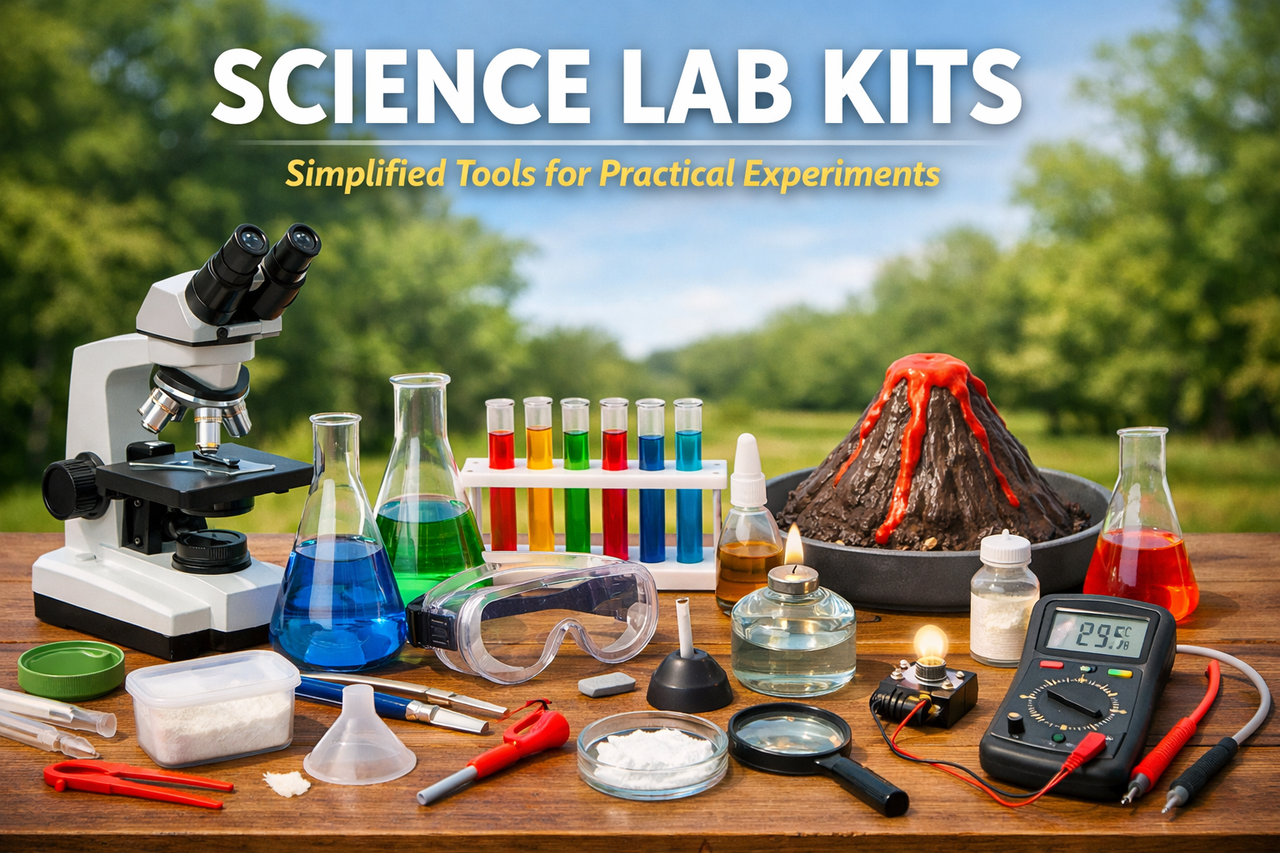
Science Lab Kits: Simplified Tools for Practical Experiments
24th Mar 2026
Science can feel overwhelming in a classroom. Too many steps, too little time, and not enough hands to help. That's exactly why Science lab kits exist. They're pre-configured instructional tools that cut setup time, improve safety, and help students focus on what actually matters: learning science. Traditional labs are often messy and hard to manage. We've seen teachers spend more time prepping than teaching. These kits change that.
What Are Science Lab Kits and Why Are They Important in Classrooms?
A science lab kit is a pre-organized set of tools, materials, and instructions. It's built to help students run specific experiments efficiently and safely.
Here's why they matter in today's classrooms:
- They reduce barriers to hands-on learning
- They fit inside a 40 to 45-minute class period
- They work for students at different skill levels
- They give every student the same starting point
Traditional labs weren't built around today's classroom reality. Teachers have tight schedules. Students come in with different experience levels. School science kits solve this by removing the guesswork from lab day.
Why Do Traditional Lab Setups Often Slow Down Learning?
Traditional labs need a lot of prep work. Teachers measure chemicals, organize equipment, and handle safety checks before the lesson even starts.
By the time students begin, 15 to 20 minutes are already gone. Students end up spending more time following setup steps than actually thinking about the science. This is where simplification isn't just helpful. It's necessary.
How Do Simplified Science Lab Kits Reduce Cognitive Load for Students?
Cognitive load means how much mental effort a task takes. When students have to manage too many steps at once, they stop thinking about the science itself.
Simplified kits remove that extra noise. Students get clear instructions, pre-organized materials, and one single focus: the experiment.
What Is Instructional Scaffolding in Lab Kits?
Scaffolding means giving students just enough support so they can succeed on their own.
In a lab kit, that looks like this:
- Pre-measured reagents so there are no measuring errors
- Pre-assembled components so there's no lost time
- Step-by-step guides written in plain, simple language
Students focus on why something happens, not just how to set it up.
How Does Micro-Scale Chemistry Improve Classroom Experiments?
Micro-scale chemistry uses small amounts. Think drops instead of beakers. This works better in school labs.
The benefits are straightforward:
- Lower safety risk for students
- Less chemical waste overall
- Faster completion within a single class period
STEM lab kits increasingly use this approach. It's not cutting corners. It's just smarter science.
How Do Science Lab Kits Save Time for Teachers During Busy School Days?
At Geyer, we've been supplying classrooms since 1960. We've worked with classrooms for decades and consistently hear the same issue: time loss during setup and cleanup. The most common complaint isn't about the experiment itself. It's about everything that happens around it.
That's why we focus on kits that are ready to use from the moment they arrive.
What Is "Rapid Reset" and Why Does It Matter?
In our experience, the biggest challenge in any school lab isn't running the experiment. It's a cleanup afterward.
Good classroom science kits are designed with this in mind:
- Modular storage that keeps everything in its place
- Color-coded components for fast sorting
- Quick reset between classes, often under 5 minutes
This matters especially in schools where the same lab room is used by four different classes in a single day.
How Durable Are Classroom Science Kits?
We source and design kits that are built for real classroom use. That means:
- Instructional-grade materials, not toy-grade
- Tools that hold up to repeated student handling
- Components that last across multiple school years
Durability isn't a bonus feature. It directly reduces replacement costs over time.
How Do Simplified Lab Kits Compare to Traditional Lab Preparation?
Here's a straightforward side-by-side comparison:
|
Feature |
Traditional DIY Lab Prep |
Simplified Lab Kits |
|
Setup Time |
60+ minutes |
Under 10 minutes |
|
Storage |
Bulky, unorganized |
Modular, stackable |
|
Consistency |
Varies widely |
Standardized results |
|
Safety |
Higher risk (bulk chemicals) |
Lower risk (pre-portioned) |
|
Curriculum Alignment |
Manual mapping |
Pre-aligned to standards |
The gap is significant. But it's worth saying clearly: a simpler setup does not mean less learning.
Are Simplified Science Laboratory Kits Aligned with Educational Standards?
Yes, and this is something we pay close attention to. Educational science kits aren't just about saving time. They're built to meet real academic requirements.
Do These Kits Meet NGSS and Curriculum Requirements?
Most kits we carry align with Next Generation Science Standards (NGSS). Each activity is connected to specific learning outcomes. Teachers don't need to figure out the curriculum link on their own. It's already built into the kit.
Can Students Still Collect Accurate Scientific Data?
Absolutely. The tools inside quality lab kits are calibrated for student use. Students collect real data, write proper lab reports, and meet the same academic standards as any traditional lab setup.
Simpler format, same scientific rigor.
How Safe Are Science Lab Kits for Classroom Use?
Safety isn't something we treat as an afterthought. It's part of how we evaluate every kit we stock, whether we sourced it or made it ourselves.
What Safety Measures Are Included in Modern Lab Kits?
- Chemicals come pre-portioned in safe, small quantities
- Instructions include clear safety steps written for students
- Exposure risks are much lower than with bulk chemical setups
How Do Teachers Stay Supported During Experiments?
Every kit includes a teacher's guide. It covers expected results, common issues, and troubleshooting tips. Teachers don't need a science background to run a successful lab session. The guide handles the hard part for them.
If you're setting up a full classroom, our guide on Science Supplies for Teachers: A Complete Lab Setup Guide explains everything in detail.
How Do Simplified Lab Kits Improve Student Engagement and Learning Outcomes?
When students aren't bogged down by setup work, something genuinely shifts in the classroom. They ask more questions. They pay closer attention to results. They actually care about what's happening in front of them.
- Hands-on learners stay engaged for longer
- Visual learners see the concept working in real time
- Every student works from the same consistent starting point
Repeatable results also build student confidence. When an experiment works the same way twice, students start trusting the process.
Wrapping Up
Simplified lab kits aren't shortcuts. They're better-designed tools for a real classroom environment. From what we've seen across decades of working with schools, the biggest change happens when students spend less time on setup and more time doing actual science.
Better learning. Safer labs. More efficient teaching days. That's what we built these kits around, and that's what we keep hearing back from the teachers who use them.
FAQs About Science Lab Kits
Are science lab kits suitable for all grade levels?
Yes. Kits vary by grade level. We carry options for middle school through high school, with the complexity scaled to match.
How much preparation is required before a lab session?
Most kits need under 10 minutes of prep. Materials are pre-organized and ready to go.
Are these kits cost-effective for schools?
The upfront cost is higher than buying loose materials separately. But you save time, reduce waste, and get multiple uses from each kit. Over a school year, the value adds up.
Can these kits replace traditional labs entirely?
Not always. Some experiments still need full equipment setups. But for most standard classroom activities, simplified kits work just as well and often more smoothly.
Do teachers need special training to use them?
No. The teacher guides are written for easy use. If you can follow clear instructions, you can run the lab confidently.
 Recently Viewed