
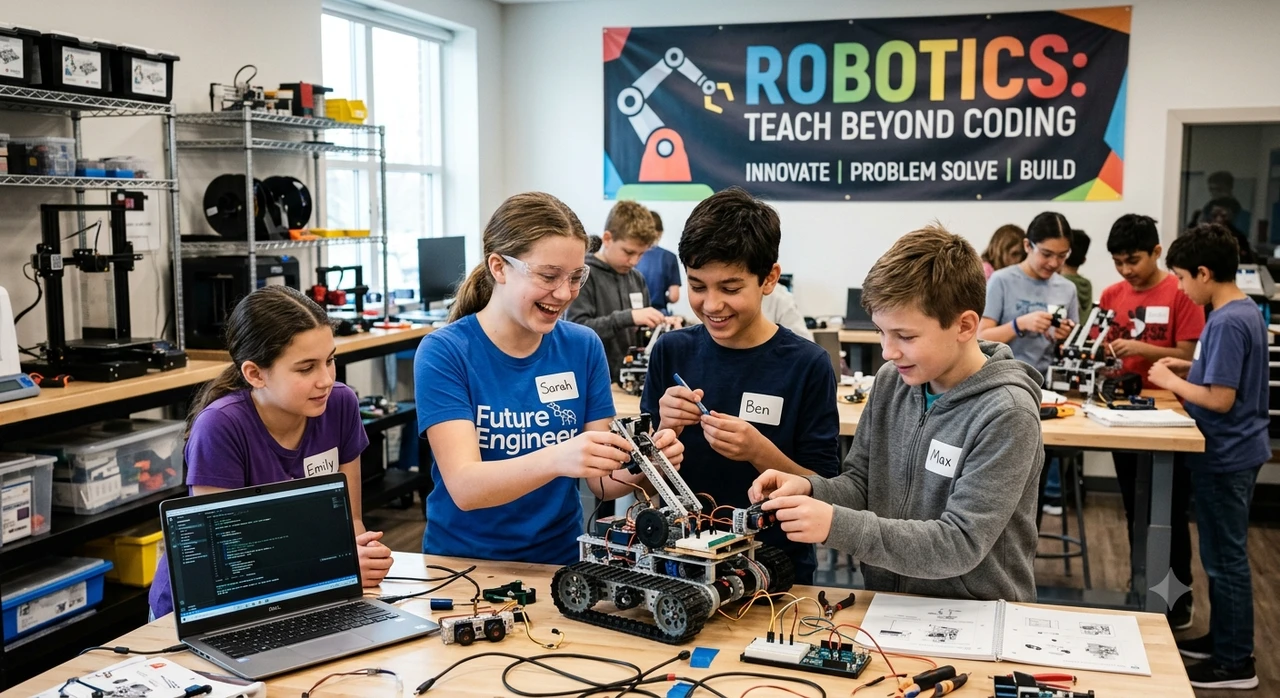
What Does Wonder League Robotics Teach Beyond Coding?
15th Oct 2026
Wonder League Robotics teaches students much more than how to program a robot. Through hands-on challenges with the Dash robot, students have opportunities to practice problem-solving, teamwork, critical thinking, creativity, and perseverance while developing important STEM skills.
The Wonder League Robotics Competition, organized by Make Wonder, brings these skills together through story-based missions that challenge students to plan, code, test, and improve their solutions. Rather than simply following programming instructions, students must figure out how to make their robots complete specific tasks.
These activities are designed to support skills that extend beyond coding and can be applied to other classroom subjects and everyday problem-solving.
What Skills Do Students Learn Through Wonder League Robotics?
Wonder League Robotics combines coding with activities that encourage students to think independently, collaborate with others, and learn through experimentation.
1. Problem-Solving and Critical Thinking
Every robotics mission presents students with a challenge that requires a solution. Students must determine what their Dash robot needs to accomplish, develop a plan, and write the code to make it happen.
When the robot doesn't perform as expected, students must identify the problem and decide what to change.
For example, if Dash stops short of its destination, students might need to:
- Review their original programming instructions.
- Check the distance and direction of the robot's movement.
- Identify which part of the code needs adjustment.
- Test their revised solution.
This process introduces students to debugging while encouraging logical thinking and systematic problem-solving.
2. Teamwork and Collaboration
Wonder League Robotics encourages students to work together toward a common goal.
Team members can contribute different ideas, discuss possible solutions, and help troubleshoot programming challenges. Students may also take on different responsibilities during a mission, such as planning the robot's movements, programming, testing, or documenting results.
Working together gives students opportunities to practice listening, communicating, and making decisions as a group.
These collaborative experiences can be particularly valuable in elementary STEM education, where students are still developing the skills needed to participate effectively in group projects.
3. Perseverance and a Growth Mindset
Robotics challenges rarely work perfectly on the first attempt.
A robot may turn too far, miss a target, or follow an unexpected path. Instead of treating these results as failures, students can use them to understand what needs improvement.
Wonder League Robotics provides opportunities for students to:
- Recognize mistakes as part of the learning process.
- Make adjustments based on test results.
- Try different approaches to the same problem.
- Continue working toward a solution when challenges become difficult.
Repeated testing and improvement can help students practice perseverance and develop a growth mindset—the understanding that skills can improve through effort, practice, and learning.
4. Creativity and Innovation
Although robotics involves programming instructions, there is often more than one way to approach a challenge.
Students can explore different coding sequences, movement patterns, and strategies to complete a mission.
For example, one team might program Dash to reach a destination using several short movements, while another might develop a different route.
Comparing approaches encourages students to think creatively and consider alternative solutions.
This combination of creativity and technical problem-solving is an important part of STEM and STEAM education.
5. Communication Skills
Students must do more than write code when working as a team. They also need to explain their ideas and help teammates understand their reasoning.
During robotics activities, students can practice:
- Describing how their code is supposed to work.
- Explaining why a robot did not complete a task.
- Sharing suggestions for improving a solution.
- Discussing results and agreeing on next steps.
These activities create opportunities to strengthen communication skills alongside technical knowledge.
6. Spatial Reasoning and Mathematical Thinking
Wonder League Robotics connects computer programming to movement in the physical world.
Students must consider distances, directions, turns, and positioning as they program Dash to navigate a competition mat.
For example, a mission may require students to estimate how far the robot needs to travel, determine the correct direction, or adjust its turning angle.
These challenges provide practical opportunities to apply mathematical concepts such as measurement, geometry, sequencing, and spatial relationships.
How Do Wonder League Missions Help Students Practice These Skills?
One of the distinguishing features of Wonder League Robotics is its use of story-based missions.
Rather than presenting coding as a series of unrelated exercises, the competition places programming challenges within a larger story.
Each season introduces a theme, and teams complete missions that connect robotics and coding to problem-solving scenarios.
Students work through a process that resembles the engineering design cycle:
- Understand the challenge: Identify the mission's objective and requirements.
- Develop a plan: Decide how the robot should move and what actions it needs to perform.
- Write the code: Program Dash to carry out the planned sequence.
- Test the solution: Run the robot and observe the results.
- Make improvements: Adjust the code and test again.
This approach helps students see coding as a tool for solving problems rather than simply an exercise in learning programming commands.
Why Is the Physical Robotics Mat Important?
The Wonder League Robotics competition mat adds a hands-on component to the coding experience.
Instead of watching instructions execute only on a screen, students see how their programming decisions affect a physical robot.
The full-size competition mat measures 150 cm × 240 cm (approximately 5 × 8 feet) and provides a defined surface for robotics challenges.
Depending on the mat design, students can use printed grids, coordinates, and other visual references to plan and evaluate their robot's movements.
Working on a physical mat gives students opportunities to:
- Estimate and measure distances.
- Understand direction and positioning.
- Practice spatial reasoning.
- Connect mathematical concepts to real-world movement.
- Observe how changes in code affect a robot's performance.
For example, students may program Dash to move between two locations on the mat. If the robot travels too far or turns incorrectly, they can compare the intended route with the actual result and adjust their code.
This connection between programming and physical movement makes abstract coding concepts easier to explore through hands-on activities.
How Can Teachers Use Wonder League Robotics in STEM Education?
Wonder League Robotics can be incorporated into several educational settings, including elementary classrooms, STEM programs, robotics clubs, after-school activities, and homeschool learning.
The competition offers two age divisions:
- Innovator Cup: Ages 6–8
- Pioneer Cup: Ages 9–12
These divisions provide age-based opportunities for students to participate in robotics challenges.
Teachers can also use Dash robots and compatible robotics mats for additional learning activities outside the competition.
Classroom STEM Activities
Teachers can use robotics challenges to reinforce coding, mathematics, problem-solving, and collaboration.
For example, students might program Dash to travel a measured distance, follow a planned route, or navigate between locations on a grid.
Robotics Clubs and After-School Programs
Robotics clubs provide opportunities for students to work on longer challenges, collaborate with teammates, and explore different programming strategies.
The competition format gives teams a shared objective while allowing students to practice coding and troubleshooting.
Cross-Curricular Learning
Robotics can also support learning in subjects beyond computer science.
Teachers might incorporate measurement and geometry into robot navigation, use written reflections to develop communication skills, or ask students to explain the reasoning behind their solutions.
These activities help connect robotics to broader classroom learning objectives.
What Do Teachers Need to Get Started With Wonder League Robotics?
Teachers and coaches interested in participating in Wonder League Robotics should begin by reviewing the current season's competition requirements.
The program uses the Wonder Workshop Dash robot and coding activities, along with physical robotics challenges.
Depending on the activities and competition requirements, teams may need:
- A Wonder Workshop Dash robot.
- A compatible device for programming.
- Access to the required coding software and competition resources.
- The appropriate robotics competition mat.
- Internet access for online competition activities and submissions.
Teachers should confirm current subscription, registration, and equipment requirements with Make Wonder's official competition website before registering.
Geyer Instructional offers a selection of Wonder Workshop robots and accessories and Wonder League Robotics competition mats for classroom and competition use.
Why Does Learning Beyond Coding Matter?
Coding is an important part of STEM education, but the ability to apply technical knowledge to solve problems is equally valuable.
Wonder League Robotics gives students opportunities to practice programming while working through challenges that involve planning, communication, teamwork, and creative thinking.
Students experience how an idea can become a working solution through experimentation and improvement.
These are educational opportunities built into the program's activities, rather than guarantees of specific learning outcomes for every participant.
For teachers looking to introduce hands-on robotics, Wonder League provides a structured way to bring coding and broader STEM skills together.
Frequently Asked Questions About Wonder League Robotics
What skills does Wonder League Robotics teach besides coding?
Wonder League Robotics gives students opportunities to practice problem-solving, critical thinking, teamwork, creativity, communication, perseverance, and spatial reasoning. Students apply these skills while completing story-based robotics challenges using the Dash robot.
How does Wonder League Robotics encourage teamwork?
Students work together to plan solutions, program their robots, test results, and troubleshoot challenges. These activities encourage communication, shared decision-making, and collaboration.
Does Wonder League Robotics help students develop problem-solving skills?
Wonder League Robotics is designed to encourage problem-solving through hands-on programming challenges. Students must identify objectives, develop solutions, test their code, and make adjustments when their robots do not perform as expected.
What age groups can participate in Wonder League Robotics?
The Wonder League Robotics Competition has two age divisions: the Innovator Cup for ages 6–8 and the Pioneer Cup for ages 9–12.
How does Wonder League Robotics connect to math and STEM education?
Students use coding, measurement, sequencing, spatial reasoning, and logical thinking to complete robotics challenges. Teachers can connect these activities to mathematics, engineering, computer science, and broader STEM learning objectives.
Do students need previous coding experience to participate?
Wonder League Robotics includes coding activities designed for younger learners. Students who are new to robotics may benefit from introductory Dash programming activities before attempting competition missions. Teachers should review the current season's requirements and recommended preparation materials.
Bring Hands-On Robotics Into Your Classroom
Wonder League Robotics combines coding with opportunities for students to practice teamwork, creativity, critical thinking, and problem-solving.
Whether you're preparing a competition team or introducing robotics into your STEM curriculum, the Dash robot and compatible robotics mats can help bring programming concepts into the physical classroom.
Explore Wonder League Robotics mats and Wonder Workshop products at Geyer Instructional to find equipment for your next robotics activity.
 Recently Viewed